WhatsApp AI Voice Bot: Commerce Blueprint
Most WhatsApp automation is fake progress. It looks efficient in a dashboard, then falls apart the second a real customer sends a voice note, changes their...

Most WhatsApp automation is fake progress. It looks efficient in a dashboard, then falls apart the second a real customer sends a voice note, changes their mind mid-sentence, or asks for something that wasn't in the flow.
A few years back, we made that mistake ourselves. We treated voice like a thin add-on to chat. Bad idea. A real WhatsApp AI voice bot isn't a nicer IVR and it isn't a glorified transcription tool. It's a commerce system with ears, memory, and permission to act. And the numbers are getting hard to ignore: according to 2026 reports from eGrow, AiSensy, Versatik, and Twilio, the gap between toy bots and production voice agents now shows up in resolution rates, latency, and cost per interaction. This blueprint breaks down what actually matters across six sections.
What is a WhatsApp AI voice bot?
76% to 92%. That's the share of customer interactions the 2026 eGrow report says WhatsApp AI agents can resolve on their own. I think that's the only number most teams should care about, because "sounds natural" is cute right up until a customer still can't get a refund without a human stepping in later.
People usually describe this thing like it's obvious: a chatbot, but with voice. Sure. That's the version you put on a slide. It's also how teams end up buying the wrong stack and wondering why conversion drops two weeks after launch.
I saw that happen in April. Retail brand. Paid ad clicks were coming into WhatsApp. A customer sent a voice note asking about delivery, got bounced to a web form, then got told to install an app for tracking. Three jumps. Done. Lost sale. Not because pricing was off or the product sucked. Because nobody taps an ad hoping for homework.
That's what a WhatsApp AI voice bot is really there to fix. The customer stays inside WhatsApp, speaks like a normal person, and finishes the task there instead of getting kicked across three systems that don't talk cleanly to each other.
The labels don't help. People throw everything into one bucket and call it automation.
A plain chatbot is mostly text. Good enough for FAQs, basic routing, maybe an order-status check.
A voice bot for support handles spoken input and spoken replies. So yes, it needs speech-to-text (STT) to understand audio and text-to-speech (TTS) to answer back out loud.
A WhatsApp voice chatbot—I'd call it an AI voice assistant for WhatsApp, because that's closer to what's actually happening—does both inside the WhatsApp Business API. It takes a voice note, converts it to text, sends that into conversational AI or an LLM-powered voice agent, decides what should happen next, then replies in text or generated audio.
The middle part matters more than the voice part. Action. That's where good demos die.
Clever replies are cheap now. Resolution isn't. The useful version doesn't just explain policy or paraphrase your help center; it does the job. Create an order. Process a refund. Change shipment details. Update CRM records. If it can't finish the work, you've built a talking detour.
That's also why staying in-channel matters so much. Your customer already lives in WhatsApp. Push them to your website and some disappear. Tell them to install an app and more vanish. I've watched teams defend a 14-field form as "fast" while abandonment climbed anyway; one brand I worked with was losing people before field seven, which tells you everything you need to know.
Voice has another failure mode: lag. If replies drag, people assume it's broken or fake-smart in the worst way.
The 2026 Versatik report put streaming architecture with solid latency optimization at roughly 400-800 milliseconds response time, versus about 1.5 to 2 seconds in a naive pipeline. That gap doesn't sound dramatic until you hear it in conversation. Under a second feels alive. Two seconds feels awkward, especially on mobile, especially if someone's trying to sort out a late package while walking into work.
If you're planning your own WhatsApp commerce automation, don't start by listing questions customers might ask. I'd argue that's backward. Start with the actions they want completed by voice inside chat: changed, booked, refunded, confirmed. Pick the jobs first. The technical choices get easier after that, not before. This WhatsApp voice AI integration architecture guide is a solid next read—because if your bot can talk but can't finish anything, what exactly did you build?
Why WhatsApp voice matters for commerce and support
Everybody says the same thing: WhatsApp matters because that's where customers are. True. Also incomplete.
I've watched teams nod along with that idea, then botch the part that actually decides whether a sale happens or a support issue gets fixed. They treat voice like a file upload. Customer speaks, system transcribes it, text goes into the same old queue, somebody or something replies later in a tidy paragraph, and everyone acts surprised when the moment dies.
One Thursday at 4:17 p.m., a customer sent a voice note: “If I order now, can this ship tomorrow?” Simple question. Should've taken seconds. Instead it got turned into text, dumped behind typed tickets, and answered after the buying mood had already cooled off. I've seen that movie before. Completion rates dropped. Support sounded fake. The customer picked voice because typing was the annoying option, and we forced them right back into it.
People don't use WhatsApp like email. They fire off quick messages while walking into a store, juggling a kid, standing in line for coffee, sitting in the passenger seat with 8% battery left. Voice wins in those moments because it's easier, faster, and sometimes the only practical input.
The missing piece is rhythm.
Not “messages.” Turns. Someone speaks. Your system understands fast. It replies right away. Miss that beat and the whole exchange feels broken, even if the transcript is flawless.
The numbers aren't subtle. eGrow reported in 2026 that modern WhatsApp AI agents respond in under 3 seconds. Sounds decent until you compare it with what Softcery reported in 2026: speech-to-speech voice agents can work with only 200 to 300 milliseconds of delay. I'd argue that's the real line that matters. Three seconds can feel like waiting. A few hundred milliseconds feels like you're being heard.
Commerce gets decided there. Inside that tiny pause.
If someone asks by voice, “Can this ship tomorrow if I order now?” your AI voice assistant for WhatsApp can't lumber through some bloated process and come back half a minute later with stiff text. It should run speech-to-text (STT), pass intent into conversational AI, check availability, then answer immediately with clean text-to-speech (TTS) or text. Fast turn-taking keeps intent alive. Slow turn-taking gives doubt room to grow.
Support's harsher about this than commerce is.
A failed payment. A wrong delivery address. Nobody sending a WhatsApp voice note about those problems wants to hear “please choose from these options.” They want progress. eGrow's 2026 report says current agents can understand natural language, remember conversation history across messages, and take action inside real systems instead of only replying back. That's why an LLM-powered voice agent beats a menu tree pretending to care.
I think teams obsess over transcript accuracy because it's easy to score and easy to demo. Customers don't grade you that way. They notice dead air first. Always.
- Treat voice as first input, not text with audio attached. People speak in half-sentences on WhatsApp. They interrupt themselves, switch phrasing mid-thought, talk with accents, send quick follow-ups, leave things implied.
- Optimize for turn latency. If the pause is long enough for someone to check Instagram or open another support channel, you've already lost ground. Real latency optimization work matters more than flashy demos.
- Connect action to reply. Your WhatsApp voice chatbot should check orders, update records, confirm bookings, or move checkout forward inside the same flow.
- Keep replies short. Voice on WhatsApp isn't a podcast. It's quick service.
If you're building this seriously, read Buzzi AI's AI voice bot for WhatsApp CX blueprint. Good next step if you want your WhatsApp STT TTS bot, your voice bot for customer support, and your broader WhatsApp commerce automation stack to act like one system instead of five tools taped together.
If your customer chose voice because they wanted less effort, why are you making them wait for a transcript?
WhatsApp AI voice bot architecture: STT, TTS, and latency
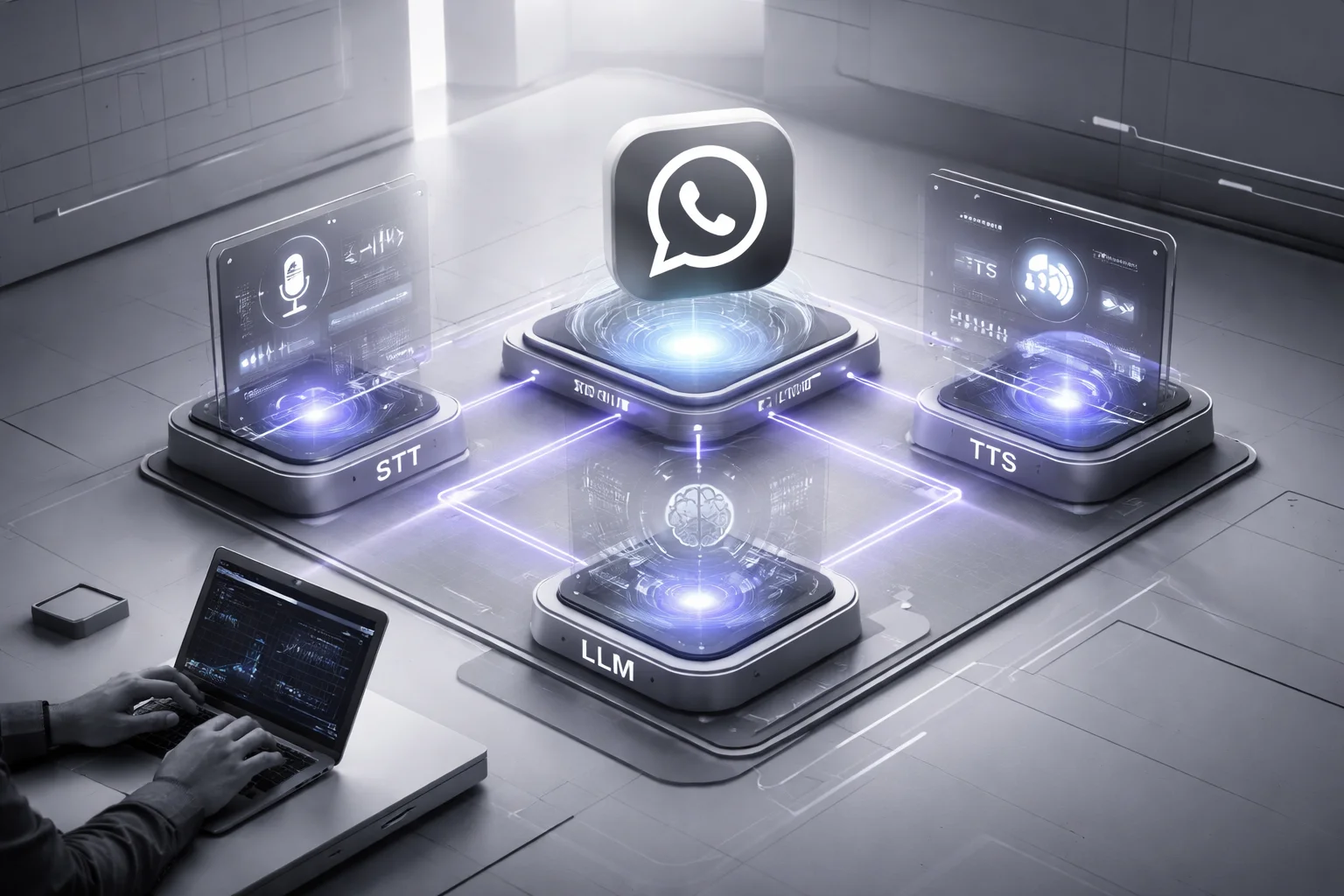
Everybody says the same thing first: WhatsApp comes in, STT turns speech into text, an LLM figures out the answer, TTS turns it back into audio, WhatsApp sends it out. Clean diagram. Nice arrows. Looks great in Figma.
It's also missing the part that actually decides whether anyone keeps talking to your bot.
1.1 seconds. Twilio used that number in its 2026 cascaded voice-agent example for total mouth-to-ear latency. I'd argue that single number is more honest than ten architecture slides, because the customer never sees your pipeline anyway. They feel delay. That's it.
A support user sending a voice note at 8:17 p.m. about a late package isn't grading your system design. They're waiting to see if the reply lands fast enough to be worth sending the next note. Same with COD confirmation. Same with payment reminders. Same with abandoned-cart follow-up.
That's where the usual advice starts to break down. Teams build these things like factory lines: download the audio, transcribe all of it, reason over it, synthesize speech, send it back. Neat. Orderly. Wrong for production.
The path underneath is still familiar enough: the WhatsApp Business API receives the voice message; your app fetches the media file; audio gets normalized; transcript goes through speech-to-text; transcript plus session history moves into orchestration; an LLM or rules engine decides what to do; backend systems handle actions like order checks or payment status; a response is generated; text-to-speech may render audio; then text or voice goes back through WhatsApp.
On paper, that's linear. In real systems, it can't afford to be.
The good builds overlap work. They keep decisions small. They don't sit around waiting for every stage to finish like employees in a broken approval chain. The bad builds do exactly that, and then people wonder why one WhatsApp STT TTS bot feels quick while another sounds half-asleep.
And here's the part people still get wrong: this usually isn't a live phone call with continuous duplex audio. It's WhatsApp. Most turns are asynchronous voice notes, not some sci-fi full-duplex conversation where both sides interrupt each other in real time. So chasing perfect call-center theater can be a waste of energy. Each turn just has to feel fast, relevant, and sane.
I don't buy the “just use the best model” pitch anymore. After a point, for an AI voice assistant for WhatsApp handling support or commerce, your latency budget matters more than your benchmark screenshot.
A practical split? Give around 200-400 ms to media fetch and audio preparation. Keep STT tight. Keep orchestration disciplined. Make TTS faster by saying less. Customers asking for delivery status or account help don't need a 45-second spoken essay telling them their parcel is out for delivery.
Zoko pushes the broad promise here: abandoned-cart recovery, delivery notifications, product recommendations, payment reminders, 24/7 support on WhatsApp. eGrow says these agents can run around the clock in 50+ languages. Fine. That's all useful on paper. But if every spoken reply drags by another second or two, those features stop mattering pretty quickly.
The boring operational stuff decides most of this outcome anyway. Voice notes arrive compressed. Durations vary wildly. Background noise is messy. Pauses get weird. Cheap Android microphones from somebody standing near traffic can wreck input quality before your system even starts thinking.
So do the unglamorous work early: normalize sample rate first, trim silence where it's safe, preserve original media metadata so debugging isn't guesswork later, and cap oversized files before they clog downstream services. I once saw a team burn almost two extra seconds per turn because untouched audio blobs were bouncing across three services before cleanup happened. About 1.8 seconds gone for no good reason. Brutal stuff.
Retries are another place teams sabotage themselves.
- Retry media fetch if the file download fails.
- Retry STT once if low confidence looks like transport trouble instead of genuinely bad audio.
- Fallback to text if TTS hangs or stalls.
- Escalate or hand off when payment changes, shipment updates, or account actions can't be confirmed safely.
A decent voice bot for customer support doesn't pretend certainty it doesn't have. It recovers cleanly or gets a human involved.
I think that's the real split: are you optimizing components, or are you optimizing turns? Component thinking wins demos for five minutes with technical buyers. Turn thinking survives Tuesday afternoon traffic spikes, flaky order APIs, noisy customer audio, and impatient users who won't wait around for your stack to get its act together.
If you're building one now, start with speed per turn: overlap whatever can overlap, keep answers short, clean ugly audio early, and treat fallbacks as product behavior rather than emergency duct tape stuck on after launch. If you want the deeper build pattern behind this WhatsApp voice AI integration architecture, pay attention to how session state, backend actions, and latency control work inside one system instead of pretending they're separate concerns.
That's what makes WhatsApp commerce automation feel useful instead of sounding like mechanical plumbing dressed up as conversational AI. So really—if your bot can't answer fast enough to earn the next voice note, what did all that architecture actually buy you?
Session management and consent patterns that actually work
What, exactly, is your bot supposed to remember?
People get hypnotized by the savings number. 12× cheaper. That's eGrow's claim in its 2026 report comparing WhatsApp AI agents with human agents per interaction. Fine. Great headline. I've watched teams read that stat and immediately start acting like a WhatsApp AI voice bot is some tireless little genius that can absorb every message, hang onto every detail, and never make a weird decision.
That's how you end up cleaning up nonsense on Friday afternoon. A customer sends a 14-second voice note on Monday. Tuesday they come back with one word: “yes.” The system shrugs and picks a meaning. Order tracking? Address change? Payment approval? I've seen that kind of mess happen in less than a week, and suddenly the “cheap” automation is burning support hours and giving compliance people heartburn.
Model choice gets all the attention. I think that's backward. The boring part matters more.
The thing that actually keeps a WhatsApp voice chatbot usable isn't some magical model memory trick. It's session rules. Plain ones. Tight ones. Without them, you get strange transcripts, duplicate actions, and handoff chaos nobody wants to own.
I'd start the session on intent, not on media receipt. A voice note showing up in WhatsApp isn't blanket permission to treat everything as active forever. The session should begin only after the user makes a meaningful request like “track my order” or “change delivery address.” Not before.
Then I'd get strict about turns. One inbound voice note or text equals one turn. Your AI voice assistant for WhatsApp replies once, then waits. No overeager stack of follow-up prompts unless the user asks for more. Bots get pushy fast. Users notice even faster.
Memory needs to be shorter than most teams want it to be. n8n's 2026 template uses a window of 10 interactions per user, and honestly, that's a sane default for commerce flows. Enough context to finish the task. Not enough old baggage to let something from eight messages ago poison what's happening now.
You need two clocks running at the same time. One short inactivity timeout for conversational rhythm — usually a few minutes. One longer business timeout for task state — often hours. If somebody disappears halfway through payment or never confirms an address, close the chat layer but keep the transaction state in your CRM or order system.
That's the answer to the question up top: your bot shouldn't be asked to remember much on its own.
But people always want it to anyway.
The cleaner way back in is system state, not model memory. Telnyx has been pretty explicit about this: WhatsApp AI agents can connect with CRMs, order databases, and ticketing tools while keeping context across the conversation. That's what lets someone come back after dinner, after a dropped call, after spotty service, and continue from actual records instead of whatever the model vaguely thinks happened earlier.
Consent is where teams suddenly start sounding terrified. Don't do that. Say it plainly: audio may be transcribed with speech-to-text (STT), responses may be generated by automated systems, and replies may come back as text or text-to-speech (TTS). Before collecting payment details or sensitive account data by voice, ask for confirmation first. Give people an easy exit too — “Reply STOP to switch to human support” or “Send text instead of voice.”
A good WhatsApp STT TTS bot keeps less than your team will ask for. Store transcripts only as long as needed for service, analytics, or dispute handling. Split raw audio from customer profile data whenever you can. Log consent status, opt-in source, processing purpose, and every handoff event. If you're running a voice bot for customer support, building around conversational AI, or pushing harder into WhatsApp commerce automation, that's what stops operations and compliance from fighting three months later over some transcript nobody should've kept.
Take the cost advantage if you want it. Just don't confuse cheap interactions with safe ones. Define sessions on purpose, keep memory short, restore state from real business systems, make consent obvious enough that nobody has to guess — otherwise what do you think your bot is remembering?
Integrating WhatsApp voice bots with CRM and payments
Thursday afternoon, 4:17 p.m., and a retailer's support queue was already ugly. A customer sent a WhatsApp voice note asking for one tiny change: move delivery from Thursday to Friday. The bot sounded polished. Calm voice. Clean pacing. Total mess underneath. It matched the wrong Salesforce contact, pulled stale order data, and kicked off a support cleanup that burned three agents for 27 minutes.

I've seen the same movie with payments. Someone says, “Use the card I paid with last time,” and the bot acts like it has x-ray vision into billing history. It doesn't. No reliable CRM match. No permission check. No payment authority check. No write-back after the action. Just a very confident guess, which is about the worst thing you can automate.
That's the part people miss.
They get hung up on accent tuning, model quality, turn-taking, how natural the pauses feel in a WhatsApp AI voice bot. Nice demo stuff. Not the thing that gets you paid. I'd argue the real test is uglier: can the bot safely do work inside Salesforce, your order system, your ticketing tool, and your payment stack without making humans mop up after it?
A WhatsApp voice chatbot shouldn't behave like a charming FAQ reader with good manners. It should behave like an action layer sitting on top of systems of record.
That sounds obvious until you watch weak builds hit the dangerous requests. “Refund the duplicate charge.” “Send it to my new address.” “Please reschedule this order for Friday.” If your AI voice assistant for WhatsApp hears intent and then improvises a reply before it has identity, live system state, permission, and logging sorted out, you're not automating operations. You're creating delayed support debt.
The cleanest way I've found to tell whether a setup is real or just dressed up nicely is to look at what happens first.
Conversation-first architecture hears the request, writes a smooth response, and leaves the ugly parts for an agent or some middleware bandage later.
System-first architecture does the boring work upfront: resolve identity, pull CRM history, check current order status, verify permissions, write ticket events, then answer.
One sounds smart. One actually closes work.
If you want a voice bot for customer support to handle real business inside WhatsApp, here's the order I'd use:
- Start with identity and session matching. Before your LLM-powered voice agent decides anything, tie the WhatsApp phone number to the right CRM contact ID and any active orders tied to that person.
- Then classify intent. Run speech-to-text (STT), label the request, score confidence, and mark risk so “where's my package?” doesn't get treated like “refund my last payment.”
- Pull live system truth. Check what's true right now in the order platform, subscription system, or helpdesk—not what was true six hours ago when some sync last ran.
- Ask for explicit confirmation. Keep it short in text-to-speech (TTS) or text: “I can move delivery to Friday for order 1842. Reply yes.” Short wins here because people absolutely miss long read-backs in voice notes.
- Commit the action and log everything. Write back to CRM, payment logs, and the support timeline so whoever touches that case next isn't piecing together scraps from five systems.
Voice makes all of this less forgiving than text. People mumble yes. They talk fast. They say “no wait” half a second after what sounded like approval. They change direction mid-note. Your WhatsApp STT TTS bot can't treat inferred intent as approved action for refunds, address changes, or payment capture. That's how money walks out the door.
A lot of vendors still sell full automation like it's always the prize. I don't buy it. AiSensy reported in 2026 that properly designed WhatsApp chatbots can handle 60-80% of incoming inquiries without human help. Fine. The leftover 20-40% is usually where margin gets torched anyway—payment disputes, fraud flags, policy exceptions, duplicate orders, emotionally charged failures. That's not some flaw in automation. That's where it should stop.
Buzzi AI has made this point too: voice-first WhatsApp automation lives or dies on architecture. They're right about that. Latency decides whether people stay in the flow long enough to finish it. STT and TTS cost control decides whether more volume helps or hurts you. Observability decides whether you notice failure before customers do.
I wouldn't overcomplicate monitoring either. Track four things or admit you're flying blind: message volume by flow step, integration timeouts by system, handoff rate by intent class, and error rate after confirmation prompts.
If those four numbers aren't on someone's screen every week, your WhatsApp commerce automation can sound natural while quietly leaking cash in the background.
If you're building this now, Buzzi AI's Ai Voice Bot For Whatsapp Strategy is useful because it keeps bot behavior tied to backend control instead of pretending those are separate projects. And really—if your bot can't verify identity, check payment authority, and write back cleanly, what exactly is all that polished voice buying you?
Monitoring, ROI, and a voice-on-WhatsApp case study
91%. That's the share of conversational AI interactions happening on WhatsApp, according to AiSensy's 2025 report. I winced the first time I saw that number, because it kills the comforting idea that WhatsApp is some side project you can patch later. If your WhatsApp voice chatbot is clumsy there, you're not missing edge cases. You're fumbling the front door.

And yet teams still show off transcript accuracy like they've won something. "Sector 14" recognized at 97.4% confidence. Great. Your CFO doesn't care. I'd argue they shouldn't care unless that accuracy turned into fewer agent escalations, more completed orders, and less support drag without creating a fresh mess somewhere else.
That's the part people avoid because ROI is annoying to measure. Accuracy feels neat. Money never does. A session can sound polished and still fail where it counts.
- Containment rate. Did the voice bot for customer support actually finish the task without handing the customer to a human?
- Order completion rate. How many users started checkout or reorder flows, then actually paid or confirmed cash on delivery?
- Average handle time. From the first voice note or text to final resolution.
- Drop-off by step. Identity check, product selection, address capture, payment confirmation, post-purchase help.
- Voice turn quality. STT confidence, TTS failure rate, and per-turn latency after latency optimization.
The sneaky problem sits in measurement. n8n's 2026 workflow guidance spells out that bots now work across text, voice messages, images, and PDFs while keeping memory across turns. Useful, sure. Also a perfect setup for lying to yourself with a single "successful session" metric. Someone sends a voice note at 2:14 p.m., uploads a prescription photo at 2:16, gets all the way to payment, then disappears. Was that session successful or not? Wrong question. Where exactly did it break?
I saw this play out in a retail reorder flow built around an AI voice assistant for WhatsApp. Repeat orders were easy. Delivery changes were mostly fine. Then users kept dropping during address confirmation. Not while choosing products. Not while reordering last week's basket. Right there, at the moment they had to stop speaking and start typing an address line by line on a phone keyboard. I've watched completion rates sink over something that small in under ten days.
The fix wasn't fancy. The WhatsApp STT TTS bot pulled the saved address, read it back in a short audio clip, asked for a yes-or-no reply, and only switched to text if something needed changing. Less effort, more completions. That's usually how this goes: not smarter AI, just less friction at the exact point people get tired.
If you're serious about monitoring WhatsApp commerce automation, stop reading transcripts like they're literature and start treating them like evidence tied to system data. Track containment by intent, drop-off by step, STT errors, TTS errors, human handoff reasons, and revenue per completed flow. Review those together every week.
If you need a better measurement model for this kind of conversational AI, start with Buzzi AI's AI voice bot for WhatsApp CX blueprint. The strange part is that the best systems usually look less impressive over time because they stop showing off and just get out of the way. Isn't that the whole point?
Where this leaves us
A WhatsApp AI voice bot works when it stops being a voice demo and starts acting like an operational layer for support, sales, and checkout inside the channel your customers already use.
Your next move isn't to chase the flashiest model. It's to tighten the basics: keep latency low, define session rules, get user consent and opt-in right, and connect the bot to CRM, payments, and ticketing so it can actually finish work instead of just sounding smart.
And watch the boring stuff like a hawk. Voice bot monitoring, conversation analytics, error rates, handoff quality, and ROI measurement are what separate a useful voice bot for customer support from an expensive toy.
Most people get this wrong by treating WhatsApp voice as a prettier chatbot. The better way to think about it is as WhatsApp commerce automation with speech-to-text (STT), text-to-speech (TTS), and real business actions wired directly into the conversation.
FAQ: WhatsApp AI Voice Bot
How does a WhatsApp AI voice bot work with STT and TTS?
A WhatsApp AI voice bot takes an incoming voice note, runs speech-to-text (STT) to turn audio into text, sends that text to a conversational AI or LLM-powered voice agent, then replies with text or text-to-speech (TTS) audio. The good setups also keep session memory, so the bot remembers what the customer said a minute ago and doesn't act like every message is the first one.
Why does voice on WhatsApp matter for commerce and customer support?
Because customers don't always want to type, especially when they're asking about an order, a refund, or a payment issue while doing three other things. According to a 2025 AiSensy report, 91% of all conversational AI interactions happened on WhatsApp, which tells you where attention already is. Voice makes that channel faster for support and more natural for buying.
How do you handle consent and session management for voice interactions on WhatsApp?
You should ask for clear opt-in before sending voice replies or storing voice-derived data, and you should make it easy for users to switch back to text. Session management matters just as much: keep context for the active conversation, set expiration rules, and log consent status so your bot doesn't guess. Back when teams skipped this, the bot felt creepy fast.
Can a WhatsApp AI voice bot connect to CRM systems and payment flows?
Yes, and that's where it stops being a demo and starts being useful. A voice bot for customer support can pull order history from a CRM, create or update tickets, and pass the user into payment and checkout integration for invoices, COD confirmation, or payment reminders. Telnyx and Zoko both describe this kind of backend-connected flow as the real value layer.
Does a WhatsApp AI voice bot actually cut support costs?
Usually, yes, if you give it narrow jobs first instead of dumping your whole support queue on day one. According to a 2026 eGrow report, WhatsApp AI agents can cost 12× less per interaction than human agents, and AiSensy says properly designed bots can handle 60-80% of incoming inquiries without human help. That's not magic, it's triage done right.
How do you reduce latency in a WhatsApp AI voice bot?
You don't fix latency with better prompts. You fix it with architecture, real-time audio streaming, and overlapping STT, reasoning, and TTS steps instead of waiting for each one to finish. According to a 2026 Versatik report, streaming voice-bot architecture can bring latency down to 400-800 ms, while a naive sequential pipeline often sits around 1.5 to 2 seconds.
What should you monitor to judge voice bot quality and ROI?
Track more than containment rate. You want conversation analytics around latency, task completion, handoff rate, error rate, repeat-contact rate, CSAT, revenue influenced, and cost per resolved conversation. Buzzi.ai has a blunt point here: voice bot monitoring should include message volumes, template failures, and integration timeouts, because broken plumbing kills ROI before the model does.
What architecture works best for a production WhatsApp AI voice bot?
The best pattern is usually event-driven: WhatsApp Business API for message intake, STT for transcription, an LLM with session memory and tool calling, TTS for spoken replies, then CRM and commerce integrations behind the scenes. Add call control and handoff rules for edge cases, plus observability for latency optimization and failures. If you skip monitoring, you're not building a system, you're running a science experiment.