Custom Deep Learning Solutions: When to Build
Most companies asking when to build custom deep learning are asking the wrong question. The real question is why they think building from scratch is...

Most companies asking when to build custom deep learning are asking the wrong question. The real question is why they think building from scratch is automatically smarter than adapting what already works.
Look, custom models can absolutely win. But most teams don't need a blank-slate build. They need a brutal assessment of their data, workflow pain, latency targets, compliance limits, and whether fine-tuning or domain adaptation would get them 80% of the value for 20% of the cost.
That's what this article covers in five sections: the signals that justify custom deep learning solutions, the traps in the build vs buy deep learning debate, and the decision framework you can use before your team burns six months and a GPU budget on the wrong bet.
What Are Custom Deep Learning Solutions?
What are people actually buying when they say they want a “custom deep learning solution”?

Not the pitch deck version. Not the one with a giant proprietary model, a fresh MLOps stack, and a budget that quietly blows past $500,000 before anyone's cleaned up the labels. I’ve watched teams chase that story because it sounds serious. Expensive has a way of dressing up as smart.
Then the meeting starts getting specific. An insurance claims team isn’t asking for “AI transformation.” They’re asking why 1,200 claim documents hit the queue on Monday morning and too many of them get routed to the wrong reviewer. A hospital imaging group isn’t begging for research glory. They want fewer misses on radiology images that don’t look like the benchmark dataset. A legal ops team doesn’t need magic. They need clause extraction that can handle the weird contract language their company’s been reusing since 2017.
That’s where this usually goes sideways. People frame it like there are only two choices: buy a generic API or build everything from scratch. I’d argue that’s the dumbest version of the decision, and somehow it’s still the one executives hear most often. Meanwhile the useful middle gets ignored — transfer learning, fine-tuning, domain adaptation — even though those are often the things that solve the real problem without turning the whole effort into an 11-month science project.
Here’s the answer: a custom deep learning solution is any system shaped around your data, your workflow, and the metric you actually care about — not necessarily a model trained from zero.
But that’s exactly where people get sloppy.
Data Society makes this distinction clearly: off-the-shelf tools are built for broad problems with broad assumptions, while custom systems are tuned to fit a specific operating environment. That doesn’t mean “start from scratch.” It means start with what already works, then adapt it if adaptation closes the gap. Lightly AI makes basically that same case: if a pretrained model already understands the base task but struggles with your domain — radiology scans, factory defect photos, legal clauses, insurer document triage — adaptation is often enough.
Most companies should stop there first. Prove it works. Then earn the right to do more.
The adoption numbers tell on everybody. Vention reported in 2025 that only about one-third of companies had moved beyond pilots into scaled AI deployment across the enterprise. That’s not because ambition is rare. It’s because execution falls apart once reality shows up: weak data readiness, inconsistent processes, no clear owner, labeling plans disconnected from business outcomes. I’ve seen a team spend six weeks debating architecture choices between two model families while nobody in the room could define what counted as a correct label on a sample of 800 records.
That’s why I think “custom” is mostly a business systems question pretending to be a technical one.
You build deeper custom solutions only after packaged tools and adapted models still miss on workflow fit, control, or performance. If compliance rules demand tighter control over how outputs are generated and stored, okay. If latency has to stay low enough for an edge device on a factory line to respond in milliseconds, okay. If production edge cases keep wrecking accuracy after fine-tuning, okay. If none of that is true, you may just be paying extra to feel sophisticated. Buzzi AI breaks down that tradeoff well here: custom generative AI development vs adaptation.
Big market numbers don’t fix bad judgment either. Precedence Research said North America held 38% of deep learning market revenue in 2025. Huge market. Real spending. Still zero proof that your company should train anything from scratch.
Why Adaptation Usually Beats Custom Build
Everyone says the same thing first: if the problem matters, build your own model. Own the stack. Control the IP. Make it defensible. Sounds great in a Q3 roadmap review. Sounds even better on a slide with a big budget number next to it.

I'd argue that's usually the wrong frame. Most teams aren't choosing between technical purity and compromise. They're choosing between something they can actually ship in eight weeks and something that'll sprawl into an eight-month experiment nobody really scoped.
I've watched this happen in rooms with six people and too much confidence. Somebody says, "we need our own model." Heads nod. Nobody asks who's handling retraining by month six, who's writing evaluation criteria before launch panic sets in, or who's paying to label 12,000 records once everyone realizes "manual review" means actual humans burning actual hours.
That's the missing piece. The hard part usually isn't originality. It's operations.
Weak data readiness kills these projects early. Messy workflows kill them faster. Evaluation standards stay fuzzy until the deadline gets close enough to hurt. Labeling always looks cheap until you do the math. I once saw a team assume annotation would take two weeks; 12,000 records later, they were staring at roughly 300 staff hours even at just 90 seconds per item, and that was before quality checks.
That’s why model adaptation versus custom development is usually a business decision before it's a research one. Transfer learning, fine-tuning, and domain adaptation let you start with a pretrained model that already knows broad language patterns, image features, or common structures. You shape it around your documents, taxonomy, edge cases, and workflow rules instead of spending months teaching a system what a sentence is or what a defect pattern looks like from scratch.
The timeline tells the story better than the hype does. If adaptation gets you to 85% to 95% of target performance in eight weeks instead of eight months, that isn't some half-hearted shortcut. It's good judgment.
The market's moving fast enough that "good enough" arrives earlier than people expect. Vention reported ChatGPT's weekly user base grew from 700 million to 800 million between July and December 2025. A jump like that usually means one thing: foundation models are getting better quickly, and teams insisting on custom work often chase gains that shrink before their project even launches.
Maintenance is where custom work starts collecting interest on every bad assumption. Version one ships. Fine. Now you own drift monitoring, retraining cycles, label updates, infrastructure tuning, and all the weird stability problems that show up after the business changes but the model hasn't caught up yet.
Adapted systems aren't easy. They're just usually less miserable. The base capability already exists, and vendor ecosystems keep improving around it.
Custom AI still matters sometimes. 24 Seven makes a practical point here: companies tend to go custom when standard tools force constant reformatting, manual workarounds, or heavy human revision before outputs are usable. That's not abstract strategy talk. That's one of the clearest signs adaptation has stopped pulling its weight.
I don't think "just buy what's on the shelf" is strategy either. That's lazy in a different outfit. Blue Orange Digital recommends a mixed approach for a reason: use packaged services for general insight, save custom deep learning for the spots where domain specificity and accuracy actually change outcomes.
Ask the boring question first. Where's the friction right now? If adaptation removes it, stop there. If people are still cleaning outputs by hand, reformatting every file type, or correcting model mistakes so often that trust collapses, you're getting close to the point where custom deep learning earns its cost.
Funny how this works out. The option people call less ambitious usually ships sooner, costs less, survives contact with reality better, and leaves enough budget to fix the workflow mess that was going to sink the whole project anyway.
Adaptation Exhaustion Criteria for Deep Learning
USD 125.65 billion. That’s Precedence Research’s estimate for the global deep learning market in 2025. Big number. I always flinch a little when I see numbers like that, because they make ordinary teams feel like they’re supposed to build something giant just to keep up.

That’s how bad calls happen.
A booming market doesn’t lower the bar for custom work. It just makes more people impatient. Your team still has to answer a boring, expensive question: is adaptation actually running out of road, or are you just annoyed that the easy fixes didn’t magically solve everything?
I saw this play out last fall, around 4:30 on a Thursday. A CTO shared his screen and told me his team had “outgrown” fine-tuning. I’ve heard that speech before, and honestly, half the time it’s frustration wearing a blazer. This one was different. He had three dashboards open. One showed benchmark scores that looked decent right up until customer-specific documents hit the system. Another showed response times blowing past the SLA during traffic spikes. A third showed legal blocking broader rollout because sensitive records couldn’t leave the client environment.
That’s not vibe-based strategy. That’s a pattern.
Data mismatch. Latency that still misbehaves after tuning. Compliance rules that kill deployment. You get all three at once, you’re not having a cute debate about transfer learning anymore. You’re staring at structural limits.
I think too many teams ask the wrong question. Not “custom or not custom.” That’s shallow. The real question is whether real fixes are still on the table. If disciplined fine-tuning still has room, stay there. If prompt changes can help, do that. If retrieval changes apply, try them properly. If workflow redesign would remove half the pain, be honest about it and make the change. If a pretrained model is already close, building from scratch or going heavily custom is usually too early.
The middle is where people fool themselves.
Fine-tuning helps for a while, then stalls below business targets for accuracy, recall, precision, or false-positive tolerance. Compression helps and latency still misses the workflow window. Caching helps and peak traffic still wrecks your SLA at 9:07 on a Monday morning. Hosted deployment works in a demo and then security or data residency rules shut it down in production review. People keep manually reformatting outputs before anyone can use them live. You can name the failure modes clearly, but transfer learning and configuration changes won’t reduce them in a dependable way.
That’s closer to when to build custom deep learning.
24 Seven says it from the business side, and I think they’re right on this part: custom AI matters most when your advantage lives in proprietary data or internal know-how, or when compliance and security rules block third-party platforms outright. Private contracts. Medical imaging archives. Claims histories. Manufacturing defect logs. Internal decision rules nobody outside your company has seen. Generic systems tend to flatten those differences because they weren’t built around how your operation actually works.
Check this before you spend six months building something you didn’t need
My rule is simple: if adaptation can still fix it, don’t build yet. If several of these remain true after a fair pilot, custom deep learning solutions start looking reasonable.
- Data mismatch: Your real data looks nothing like public training data — different language patterns, image quality, sensor behavior, or class balance — and domain adaptation still leaves obvious error pockets.
- Performance ceiling: Fine-tuning helps at first, then stalls below business targets for accuracy, recall, precision, or false-positive tolerance.
- Latency limit: Inference still misses workflow timing needs even after compression, batching changes, caching, or hardware tuning.
- Compliance blocker: Security, data residency, auditability, or regulatory requirements make hosted third-party models a non-starter in production.
- Workflow misfit: People still have to reformat outputs by hand or do heavy review before anything can be used live.
- Poor control over failure modes: You can see the mistakes clearly but can’t reduce them in a reliable way through transfer learning or configuration changes.
- Data readiness exists: You actually have enough domain data to train or heavily adapt a model responsibly, and labeling isn’t some fantasy project with no budget.
- The economics work: Better fit is likely to beat the cost of building, compute, maintenance, and slower delivery.
This is where build-vs-buy deep learning stops being philosophical and gets testable. Run a contained pilot first. Neural Concept recommends pilots before scaling custom systems so you can prove technical feasibility and business value before committing to the full stack.
If you want a cleaner side-by-side on adaptation versus custom development, Buzzi AI breaks it down here: custom generative AI development vs adaptation.
The funny part? “Adaptation failed” can be good news if you can explain exactly how it failed. I’ve watched teams burn 12 weeks chasing vague disappointment because nobody would name the problem with any precision. Evidence beats ambition every time. So what should you do now—keep tweaking because it feels cheaper, or finally admit your dashboards are already making the decision for you?
Custom Development Prerequisites You Must Prove
At 2:17 a.m., nobody cares about your architecture deck.

They care about the alert. The broken workflow. The angry Slack thread. The customer case that got misrouted because the model drifted and nobody could answer the simplest question in the room: who owns this thing now?
I’ve watched teams get hypnotized by market numbers and start spending like certainty just arrived. Precedence Research says the global deep learning market could hit USD 1,636.31 billion by 2035, up from USD 168.48 billion in 2026. Sure. Big category. Real money. I've seen forecasts like that make otherwise disciplined companies act like they’ve already won.
That still doesn’t mean your company should build a custom model.
The ugly truth sits underneath most failed projects. It usually isn’t that the model was too hard to build. It’s that the company was too flimsy to run it after launch. Paying for custom deep learning and being ready for custom deep learning aren’t the same thing, and I think people blur those two because writing a budget request feels easier than building operational spine.
Start there. Not with when to build custom deep learning. Start with whether your team can support it after kickoff, after launch, after the first bad production incident nobody planned for.
If that answer wobbles, stop. Don’t inflate scope. Don’t bring in another vendor and pretend that counts as strategy. Don’t assume more engineers can patch a business-readiness problem.
Ownership comes first, or the whole thing is theater
A lot of companies say “the AI team” owns the model. That’s not ownership. That’s fog.
If nobody owns the model after launch, don't start. You need names. Actual people. Someone has to decide on retraining, review label quality, handle production incidents, and approve model changes when performance slips.
That gap is everywhere now. Vention reported in 2024 that more than 80% of businesses had adopted AI by 2024. Adoption is common. Real ownership isn’t. Plenty of teams can get a pilot running in six weeks and celebrate it in a board update. Far fewer can tell you who signs off if precision drops three points next quarter or who investigates bad outputs on a Friday night before Monday metrics go sideways.
Your data matters more than your model opinions
I’ve sat in meetings where people argued about architecture for 45 minutes and still couldn’t answer how many positive versus negative examples they had. That’s not ambition. That’s denial.
If your data is messy, thin, or unlabeled, custom work is a bet, not a plan.
You need usable training data. You need clear ownership of it. You need a labeling plan that won’t fall apart by week three because reviewers disagree on basic definitions or because the only examples you have came from polished demo cases instead of real production conditions.
Ask blunt questions. Are labels consistent across reviewers? Does the dataset look like what actually shows up in production? Is someone responsible for fixing quality issues before they poison training?
If those answers are weak, custom isn’t the mature option no matter how polished the slide deck looks.
And yes, sometimes transfer learning, fine-tuning, or domain adaptation are just smarter. I’d argue companies underrate those paths because “custom” sounds expensive and impressive in front of executives. Impressive isn’t the same as sensible.
The business case has to survive contact with numbers
A custom model should fix a business miss you can measure. Accuracy by itself doesn’t cut it.
CustomGPT makes the threshold pretty plain: custom deep learning starts making sense when your current setup misses real business targets such as accuracy, latency, or workflow requirements. That’s the bar.
If fraud review takes 18 minutes per case and a stronger model cuts it to 6 minutes without increasing false positives, now you’ve got something real to argue for. If all anyone can say is “we think it’ll be better,” then no — you don’t have a business case yet, you have vibes wearing enterprise clothes.
If you can’t explain deployment clearly, don’t build
A notebook demo isn’t deployment.
It’s stage magic unless you already know where inference runs, how outputs enter actual workflows, what latency is acceptable, and whether your systems can take the load without choking.
This is where plenty of build-vs-buy decisions should end early and cleanly. If an adapted service fits your production constraints better than custom development would, use that instead of romanticizing bespoke work that never ships properly.
A lot of teams bury this point because it’s less exciting than model design. Bad idea. Shipping is the point.
Governance isn’t cleanup work for legal later
Security rules, audit requirements, approval paths, and failure escalation need to exist before the project gets expensive.
This stuff isn’t mop-up work at the end. It decides feasibility from day one. A booming market won’t save a team with no approval path for model changes and no escalation process when outputs start going sideways in production.
That giant forecast number from earlier? Fine. The money in deep learning is real. Still irrelevant if your criteria for custom AI development are weak.
If you want a clearer way to think about adapting a model versus building one from scratch before you commit budget and headcount, read Buzzi AI’s take on custom generative AI development vs adaptation.
So what do you actually need before kickoff?
Prove five things: your data is ready, business value is measurable, operational ownership is assigned, deployment is mapped, and governance exists upfront.
Miss even one and wait.
Honestly, “not yet” is often the strongest decision in any deep learning project framework — but can your team say that out loud before it burns six months proving it should have?
Decision Framework for Custom Deep Learning Projects
Here’s the mistake: teams treat custom deep learning like a strategy decision when half the time it’s really a panic response.
AI gets loud, a vendor walks in with a polished demo, somebody upstairs decides the company can’t look slow, and suddenly a custom model sounds inevitable. I think that’s how dumb projects get approved. Not because the case is airtight. Because urgency makes people sloppy.
I’ve watched this happen. Week one, everyone talks about differentiation. By month three, the meeting is about why 40,000 records still haven’t been labeled, why the timeline somehow doubled, and who exactly owns the thing after launch. Funny how fast “strategic initiative” turns into “whose budget is this coming out of?”
The market noise is real. Vention’s 2025 report said 88% of organizations were already using AI regularly in at least one business function. Precedence Research said in 2026 that deep learning is projected to grow at a 29.26% CAGR through 2035. Huge numbers. Doesn’t answer the actual question.
What are you really looking at here: transfer learning, fine-tuning, domain adaptation, or a true custom build?
Don’t approve it on instinct. Force a side-by-side score.
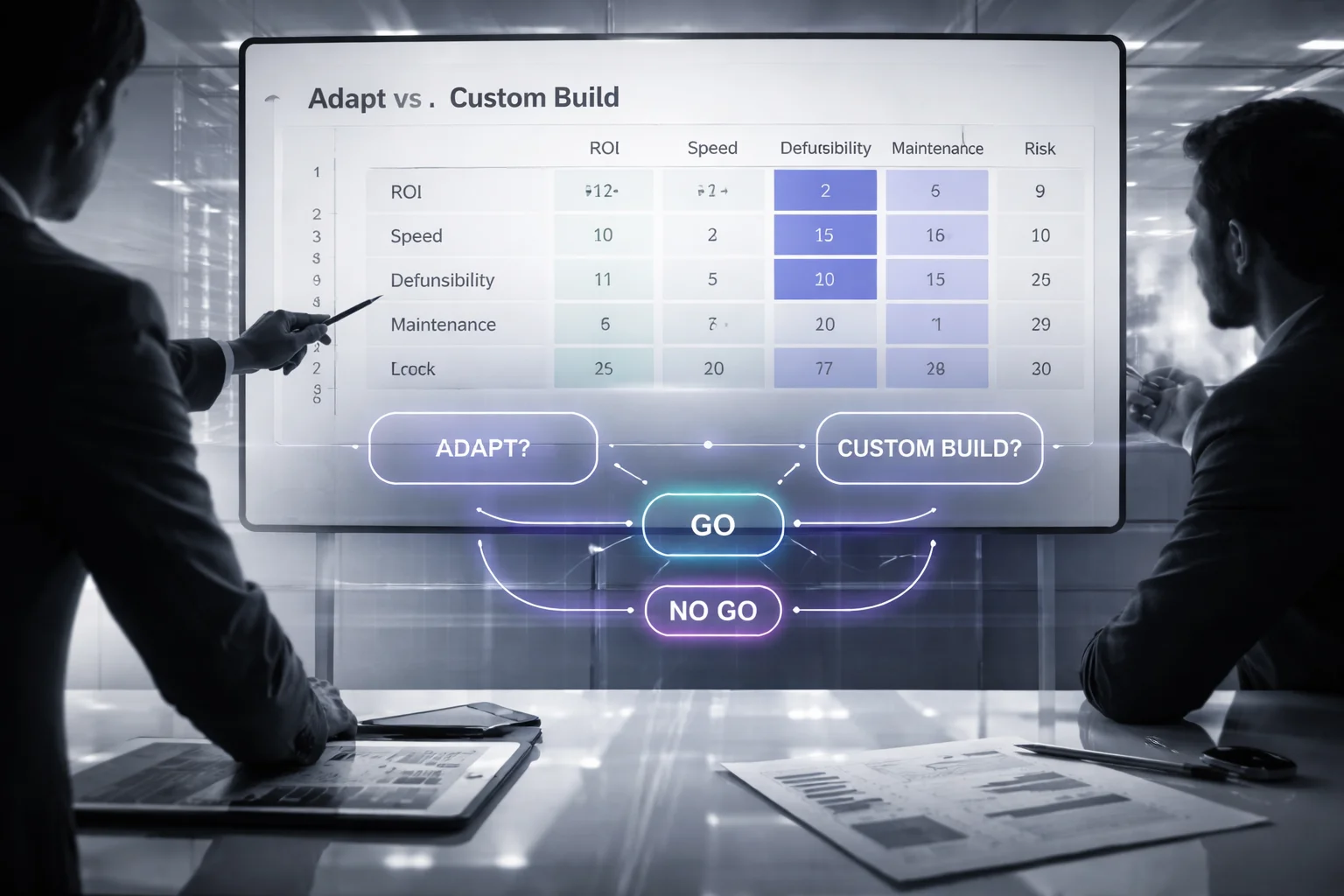
Put adaptation options together on one side. Transfer learning. Fine-tuning. Domain adaptation. Put full custom development on the other. Score each option from 1 to 5 across five factors, apply weights, then compare totals. If custom wins by less than 15%, you probably shouldn’t build yet. Not because custom is wrong. Because your advantage still isn’t obvious enough to justify the drag.
A simple scoring model
- ROI potential, 30%: Will better model fit create measurable revenue lift, cost reduction, or cycle-time savings within 12 to 18 months?
- Speed to value, 20%: Can adaptation ship in 6 to 12 weeks while custom takes 6 to 9 months?
- Defensibility, 20%: Is the advantage tied to proprietary data or weird niche workflows public models haven’t seen? ProdPad flags this as one of the strongest reasons to build your own model.
- Maintenance burden, 15%: Who handles retraining, monitoring, labeling drift, and infrastructure costs after launch?
- Risk, 15%: What’s the exposure around compliance, delivery failure, unclear labels, or shaky technical feasibility?
You don’t need magic here. You need friction. A scorecard creates just enough resistance that people have to explain themselves.
The sheet won’t make the call for you.
That part matters more than people admit. Executives love spreadsheets because they want something that feels objective enough to absorb blame later. Doesn’t work. The scorecard shows tradeoffs. It doesn’t replace judgment.
How to read the result
If adaptation wins on speed and stays close on ROI, start there. That’s usually the sane move. If custom clearly pulls ahead on defensibility and long-run economics, now you’ve got something worth backing.
A claims insurer makes this pretty plain. Say they’re testing classification and a fine-tuned model reaches 90% of target accuracy in eight weeks. That’s not a maybe. Build loses. A manufacturer dealing with proprietary sensor data and strange failure patterns is another story; domain adaptation can stall fast there while custom deep learning solutions may create actual competitive separation.
I’d argue most teams bury that distinction under ambition talk because “we built our own model” sounds better in a board update than “we adapted what already worked.” One of those saves six months sometimes.
Executive approval template
If the argument won’t fit on one page, it probably isn’t ready.
- Business problem: What metric is broken right now?
- Adaptation attempt: What did transfer learning, fine-tuning, or domain adaptation actually achieve?
- Gap remaining: Which business threshold still isn’t met?
- Criteria for custom AI development: Why can’t proprietary data or workflow fit be solved through adaptation alone?
- Cost and timeline: What will version one cost and when will it ship?
- Operating owner: Who runs it after launch?
- No-go trigger: What result kills the project early?
Twelve slides usually means somebody’s dressing up courage as strategy.
If you want a cleaner read on adaptation versus building before budget gets signed away, read Buzzi AI’s custom generative AI development vs adaptation.
The odd benefit of a real decision framework isn’t that it helps you say yes. It makes “no” sound disciplined instead of scared. How many AI budget meetings can say that?
The bottom line
You should decide when to build custom deep learning only after adaptation, fine-tuning, and domain adaptation have been pushed hard enough to fail against clear business targets, and only if your data, team, budget, and operating model can carry the weight.
Start with a technical feasibility assessment, not ambition. Check data readiness, dataset quality and bias, labeling effort, model evaluation metrics, inference latency, GPU and compute requirements, and whether you can actually run model monitoring and an MLOps pipeline after launch.
If standard tools still force manual workarounds, miss accuracy or latency goals, or can't handle your proprietary workflows, that's your signal to test custom deep learning solutions in a pilot before you scale. That's the part too many teams skip, and then they act surprised when the expensive model becomes an expensive mess.
Build custom only when adaptation is clearly broken and your business is truly ready to own the consequences.
FAQ: Custom Deep Learning Solutions
What are custom deep learning solutions?
Custom deep learning solutions are models built around your data, workflows, and business targets instead of a generic API meant for everyone. That matters when your edge comes from proprietary information, unusual inputs, or strict compliance rules. Data Society and 24 Seven both point to this gap between general-purpose tools and company-specific needs.
How do you decide between adapting an existing model and building a custom one?
Start with transfer learning, fine-tuning, or domain adaptation before you commit to full custom development. If an adapted model can hit your model evaluation metrics for accuracy, inference latency, and workflow fit, don't overbuild it. The real question in when to build custom deep learning is simple: did adaptation fail for a business reason you can measure?
What criteria show that a custom deep learning solution is actually necessary?
You should consider custom deep learning solutions when off-the-shelf models miss business targets, need constant human cleanup, or can't handle your niche domain. Strong signals include proprietary data, security limits on third-party platforms, and requirements that fine-tuning can't meet. That's the core of any serious criteria for custom AI development.
Can you build a deep learning model without labeled data?
Sometimes, yes, but don't treat unlabeled data as a free pass. You can use self-supervised learning, weak supervision, or synthetic labeling, but you'll still need a data labeling strategy for evaluation and improvement. If your dataset quality and bias are shaky, a custom model usually turns into an expensive guessing machine.
How do data quality, labeling cost, and bias affect the build decision?
They affect it more than the model choice itself, honestly. If your data is sparse, inconsistent, or biased, custom development won't save you, it'll just make the flaws harder to spot and more expensive to fix. A real deep learning project decision framework should score data readiness, labeling effort, and bias risk before anyone asks for GPUs.
Is it cheaper to fine-tune an existing model than to train from scratch?
Usually, yes. Fine-tuning cuts GPU and compute requirements, reduces development time, and lowers the risk that you spend months chasing a tiny gain. If you're doing a build vs buy deep learning review, compare total cost, not just training cost, including data prep, evaluation, deployment, and retraining.
How do compute, latency, and scalability requirements change the decision?
They can kill a promising model fast. A custom model that looks great in a notebook may fail in production if inference latency is too high, hardware costs spike, or scaling traffic breaks the serving stack. That's why technical feasibility assessment has to include serving architecture, batch vs real-time needs, and expected load.
Do custom deep learning projects need MLOps, monitoring, and retraining plans from the start?
Yes, because a model isn't done when it ships. You need an MLOps pipeline, model monitoring, rollback rules, and retraining triggers early, or you'll end up with silent performance drift and no clean way to fix it. Neural Concept recommends pilot projects before scaling, which is smart because deployment problems show up long before the board asks about ROI.