AI MVP Development Services That Validate Markets
Most AI products shouldn't be built. I've watched teams burn six figures on clever demos that looked great in a board meeting and died the minute real users...

Most AI products shouldn't be built.
I've watched teams burn six figures on clever demos that looked great in a board meeting and died the minute real users touched them. That's why AI MVP development services matter so much. The good ones don't start with models, feature lists, or architecture diagrams. They start by trying to prove you wrong, fast.
And the numbers back that up. In 2025, AI pulled in $202.3 billion in funding, according to Indie Hackers, which means more money is chasing more bad assumptions. In this article, I'll show you the six parts of a validation-first approach that tests demand before you sink months into building the wrong thing.
What AI MVP Development Services Really Mean
Hot take: most teams buying AI MVP development services aren't really buying validation. They're buying relief.
A board update. A polished click-through. A roadmap with enough arrows on it that everyone in the room can pretend progress is happening.
I think that's where the money disappears.
I've seen this movie before. Somebody asks for an "MVP," what they actually get is a shiny prototype for investors, or a proof of concept that works in a sandbox, or a model demo that looks sharp for twenty minutes on Zoom. Then the language gets sloppy. People start saying things like product-market fit as if showing motion on a screen means users care.
It doesn't.
The part people keep skipping is the awkward middle. That's the actual AI MVP.
- Prototype: shows how something might work.
- POC: proves a technical idea can work.
- AI MVP: tests whether users care enough for the idea to matter.
- Full product: assumes you already know that answer.
That's the whole distinction right there, and it matters more than most buyers realize. A real minimum viable product isn't built to calm your nerves. It's built to force contact with actual users and come back with evidence instead of reassurance.
More real than a prototype. More exposed than a POC. Way less ambitious than a full product. Kind of ugly, usually. Good. That's not a bug.
AI makes it weirdly easy to fool yourself, too. Teams love clean metrics because clean metrics feel safe. An 80% accuracy rate sounds impressive right up until nobody changes their behavior after launch. If latency drags, if users don't trust the output, if edge cases keep blowing up by day three, that nice metric doesn't mean much.
I watched an internal support tool get praised in 2023 because it answered test prompts beautifully in meetings. Live environment? Average response time was around seven seconds. Support reps bailed fast. I remember one team setting a five-second wait threshold on chat tools because anything slower got treated like broken software. Great model score. Bad product behavior.
That's why problem-solution fit matters more than model theater.
VOD Works puts AI MVP development in the context of helping startups and innovation teams validate data-heavy ideas before placing bigger bets. Fair enough. Beyond Labs says the part I'd underline twice: the point is to test assumptions early so you cut waste before doing a full build-out.
That's what buyers should obsess over.
Not feature count. Not how cinematic the demo feels. Questions first. What user pain are you testing? What behavior would count as real solution validation? What's the smallest possible validation-first AI MVP scope that gives you an honest signal instead of flattering noise?
If a vendor can't explain their approach to AI MVP hypothesis testing, user feedback, and product discovery in plain English, I'd argue you're not paying for product thinking at all. You're paying for production theater with better slides.
The brief should be brutally narrow: one user segment, one painful workflow, one measurable outcome. Build only enough to get real AI MVP market validation. That's what a learning-driven AI MVP looks like. If your team keeps mixing up stages, this breakdown of AI prototype development vs POC vs MVP will save you five meetings and probably one expensive mistake.
The funny part? Sometimes the smartest outcome is learning not to build the AI at all.
Cheap answer. Valuable answer. How often does software earn its keep by telling you to stop?
Why Development-Only MVPs Fail to De-Risk Anything
Two founders. One polished demo. Twenty-two minutes of compliments on Zoom.

I remember that meeting because everyone left feeling weirdly victorious. The AI workflow product looked sharp. Clean interface, smooth automations, the kind of thing that makes smart people nod along and say, “Yeah, I can see this.” Then real users got their hands on it and did almost nothing with it.
Not because it crashed. Not because the model was bad. Because it made their work longer.
That’s the trap.
$202.3 billion. That’s how much money AI pulled in during 2025, according to Indie Hackers. Close to half of global funding. Numbers like that do something to people. Suddenly speed feels like proof. More budget, stronger tooling, faster output, more code — and somewhere in there teams start acting like a development-only MVP lowers risk by default.
It doesn’t.
I’ve seen this show up in healthcare, fintech, logistics, enterprise SaaS — different buyers, same mistake. Teams build first and call the build itself validation. I think that’s backwards. If you haven’t tested demand, workflow fit, or willingness to pay, your MVP probably isn’t reducing much risk at all. It may be increasing it while giving everybody nicer screenshots.
We learned that the expensive way. We shipped functionality before doing enough product discovery, then told ourselves usage would reveal value. It didn’t. Nobody fought to get budget approved. Nobody pushed procurement forward. Nobody said, “We need this in next quarter’s plan.” That’s not market validation. That’s hope wearing a product roadmap.
And yeah, software teams really are moving faster now. TopsInfoSolutions reported productivity gains between 16% and 30% for high-performing teams using AI tools. Great. Useful. Also dangerous if you’re testing the wrong thing, because now you can build the wrong product in six weeks instead of ten.
If you’re paying for the work, that should make you nervous.
Weak AI MVP development services sell velocity like it equals safety. I’d argue that’s one of the most expensive stories in startup land. Risk only drops when a minimum viable product produces evidence about problem-solution fit and solution validation. Do people care? Does this fit how they already work? Will anyone spend actual money? If your MVP can’t answer those questions, you didn’t de-risk anything meaningful. You shipped code and called it progress.
The MVP isn’t there to impress your internal team first. It’s there to test the business bet underneath the whole company.
- Name the bet. What has to be true for this business to work at all?
- Tie it to behavior. If the pain is real, what would a user actually do?
- Tie that behavior to money. What counts as budget approval, willingness to pay, or real workflow adoption?
- Cut scope until learning gets sharper. That’s what a real validation-first AI MVP scope looks like.
- Run explicit tests. Good AI MVP hypothesis testing beats a long feature checklist every time.
I’d press vendors hard on this if I were buying. Are they running a real learning-driven AI MVP, or are they handing over an outsourced build plan with better branding and calling it an AI MVP development methodology? If you want a practical way to tell the difference, this guide on AI MVP development viability thresholds is worth reading.
The restaurant example still holds up because it’s so obviously dumb once you say it out loud: spending six months perfecting menu fonts before finding out whether anyone likes the food. Yet startups do the software version of that all the time — sometimes with $80,000 budgets, sometimes more — while everyone in the room keeps a straight face.
Your biggest cost usually isn’t bad code. It’s clean code attached to a bad assumption. So before you fund another sprint, what are you actually trying to learn?
The Validation-First MVP Service Scope
I watched a team burn roughly $48,000 on an AI MVP that looked great in a demo and told us almost nothing. Nice interface. Clean analytics. Slack alerts. A tidy little GPT layer on top. Two weeks later, nobody could answer the only question that mattered: did it solve a real problem for a real user, or did we just build something impressive enough to survive a Zoom call?
That's the trap.
Everybody selling AI MVP development services seems to pitch the same bundle: pick a model, wrap it in a UI, connect some tools, add analytics, make it polished enough for a demo and stable enough for a pilot. I get why teams buy that story. In 2025, the AI market was pegged at $371.71 billion, and one projection says it could hit $2,407.02 billion by 2032, according to Indie Hackers. TopsInfoSolutions says AI adoption across software teams has reached 97.5%. If your competitor can throw together a GPT-powered workflow in fourteen days, nobody wants to be stuck in a Tuesday wireframe debate.
Still, I'd argue most of that urgency gets pointed at the wrong job.
Speed changes the calendar. It doesn't tell you what you're testing, who it's for, or what evidence should count as actual AI MVP market validation instead of polite head-nodding from six people on a sales call.
The expensive mistake is mixing learning work with engineering work and pretending they're the same thing. They aren't. Same project, sure. Different purpose entirely. Treat both like pure build work and you end up paying senior developers to manufacture confidence theater.
Here's the framework I'd use.
Start with learning work.
- Pin down the problem: not “operations teams,” not “customer support,” not some hand-wavy user blob. Get specific. An ops manager manually reviewing inbound support tickets inside Salesforce and triaging them in spreadsheets because existing routing rules miss edge cases. That's something you can test.
- Name the hypothesis: write down what must be true for problem-solution fit. Example: “Ops managers will trust an AI triage suggestion if it cuts review time by 30%.” Good. That's sharp enough to prove or kill.
- Pick success metrics that hurt a little: time saved, repeat usage, task completion, pilot conversion. Behavioral proof. Not “the team liked the demo.” Not “users said it felt promising.” Those are compliments, not evidence.
- Design the fastest honest experiment: concierge flows, Wizard of Oz validation, lightweight MVP prototyping. I've seen teams learn more by manually generating 40 AI outputs for five users than by spending six weeks wiring features nobody used twice.
Then let engineering support the test instead of swallowing it.
- Build only what's needed for the experiment: input flow, output experience, logging, feedback loops, basic model evaluation.
- Draw hard scope boundaries: no full role system, no deep integrations, no “while we're here” extras unless they directly affect solution validation.
- Decide what happens after the test: iterate, narrow, or kill.
This part gets skipped because shipping software feels productive and discovery feels squishier. I've made that mistake myself. The irony is brutal: the less exciting work is usually the part that saves you from building the wrong thing faster.
KanhaSoft makes a fair point that AI MVPs can validate ideas quickly with real users while bringing intelligence in from day one through automation, adaptive UI, and dynamic feedback loops. Fine. True enough. But none of those things count as proof on their own. They're test instruments. That's it. If your scope treats automation or adaptive UI as evidence that the product deserves expansion, you're confusing motion with validation.
If you want a cleaner line before build starts, this guide on AI MVP development viability thresholds helps. A solid AI MVP development methodology separates discovery from delivery so your minimum viable product teaches you something during product discovery instead of just sitting on a roadmap looking expensive.
So before you sign anything, ask yourself: are you paying for software, or are you paying for evidence?
Market Validation Methodologies That Work for AI MVPs
Last year, I watched a founder celebrate a waitlist like he'd already won. Five days, cold LinkedIn traffic, one landing page, one shiny “Book a Demo” button, and a 14% click-through rate. Everybody in the room got louder. Then somebody asked the annoying question: would any of these people trust the output inside their actual Tuesday-morning workflow? Silence.
That’s the trap.
McKinsey’s forecast, cited by GainHQ, says 72% of organizations will deploy generative AI at scale by 2026. Big number. Bad influence. It makes shaky ideas feel urgent, fundable, almost inevitable. I think that stat has talked more founders into premature building than most investors have.
“Launch an MVP and get feedback” sounds reasonable right up until you realize the test itself might be wrong. A waitlist can tell you people like the pitch. A pricing-page click can tell you the copy worked. Neither tells you whether someone will rely on your output once it’s buried inside a real process with deadlines, mess, and consequences.
That middle layer is where AI products usually live or die. Not demand. Trust.
Start with pain, not models
If the problem doesn’t hurt enough, AI won’t save it. Early AI MVP market validation should begin with problem-solution fit during product discovery, not with model debates or architecture diagrams.
User interviews help. Watching the workflow helps more. An ugly prototype is often plenty. You’re trying to answer a plain question: is this problem frequent, costly, and irritating enough that somebody wants relief now? Not after procurement. Not next quarter. Now.
I’ve seen teams spend two weeks arguing over model selection before confirming the pain was even real. Terrible instinct. Same energy as buying a snowblower for a city that gets two inches of snow a year.
Smoke tests are useful. They’re also easy to overrate.
Smoke tests measure interest, not product truth.
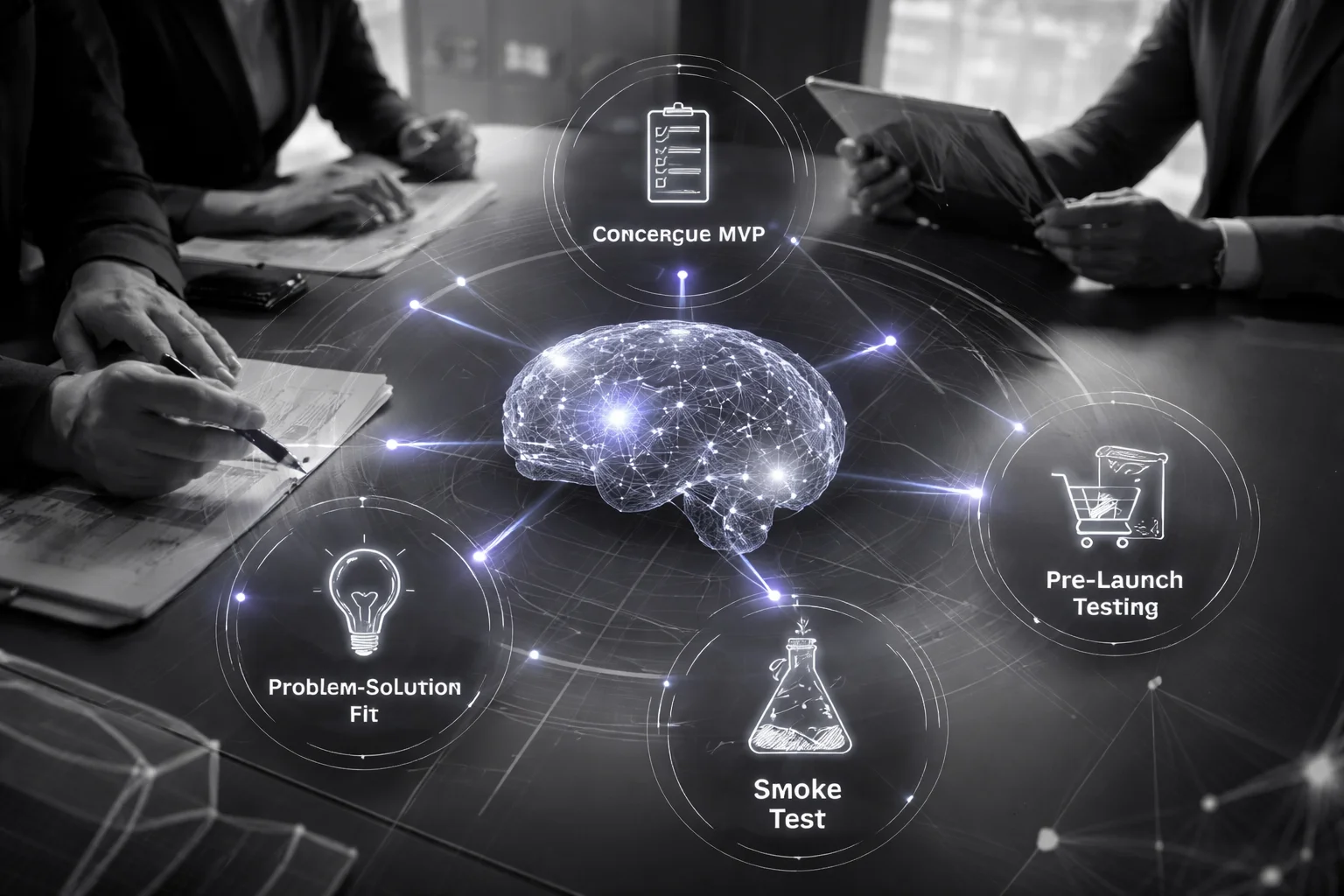
A landing page, waitlist, outbound campaign, or pricing-page click test can absolutely help with pre-launch demand testing and solution validation. They’re fast and cheap, which is exactly why people abuse them. AI promises are especially slippery here: “Instant insights.” “Automated analysis.” “10x faster decisions.” Of course people click. Curiosity is cheap.
What those tests don’t prove is whether users believe the output, whether it fits their workflow, or whether they come back after the first demo glow wears off.
The safer move is often less automation
If accuracy, trust, or workflow fit are the real risks, human-powered delivery usually beats early automation. That’s why concierge MVPs and Wizard of Oz tests work so well for AI products.
SoluteLabs calls out Wizard of Oz testing as a way to simulate AI features with humans before full automation exists. That matters because you can test whether outputs are actually useful, how quickly users expect results, and whether they trust what comes back before you sink months into pipelines or model tuning.
A concierge MVP works best when the task is high-value and low-volume. Legal document review copilots fit that shape. Sales call summaries for five or six teams fit too. A smoke test may tell you people are intrigued enough to sign up. A concierge setup tells you whether they return after seeing real output in context. Big difference.
And yes, time matters more than founders admit. According to SainaM Tech, simple AI MVPs often take 8–12 weeks, standard ones take 12–20 weeks, and complex ones run 3–6 months. Twelve weeks sounds manageable until week nine hits and nobody wants to kill what they’ve already paid for. That’s why solid AI MVP hypothesis testing has to remove risk before code starts piling up and getting emotionally expensive.
The practical rule is pretty simple even if people love making it sound fancy: use problem-solution fit testing for pain, smoke tests for interest, and concierge or Wizard of Oz methods for behavior and trust. That’s a stronger AI MVP development methodology. It keeps a validation-first AI MVP scope honest instead of padded with vanity signals.
The better question isn’t “what can we build fast?” It’s “what could kill this first?” No pain? No demand? No trust? Pick the test that answers that exact risk. If your plan still boils down to “build something and see,” what are you really learning?
How to Integrate Hypothesis Testing into AI MVP Delivery
Everybody says the same thing about AI MVPs: move fast, get something in front of users, iterate from there. I get why that sounds good. Tools are better, prototyping is cheap, and nobody wants to be the team still debating while someone else ships.
But that advice is half-baked.
I think the bigger mess isn’t slow delivery. It’s teams shipping quickly with no shared definition of success, failure, or proof. They call it a hypothesis, but most of the time it’s just a nice sentence in a workshop doc that never survives contact with delivery.
You’ve probably seen the version where everyone agrees that “users will trust AI recommendations if they save time,” then engineering gets the green light and acts like the thinking is finished. It’s not. If that statement never turns into instrumentation, review checkpoints, and kill criteria, it’s not doing any work. It’s just comforting language.
I saw one team burn six weeks like this. Midway through, they were roughly $60,000 in. Everybody loved the idea that faster work would create trust in the AI. Fine. Except nobody defined trust. Nobody chose a number for time saved. Nobody said what failure looked like. So by the end they had dashboards full of clicks, sessions, and all the usual vanity fog, and barely any real AI MVP market validation.
That’s the part people miss with AI. A normal minimum viable product already has enough risk built in. AI stacks more on top before users even react: data dependency, model accuracy issues, latency, inference cost, bias detection, compliance, security, model drift. PixelPlex has been pretty direct about that, and they’re right. Your AI MVP hypothesis testing can’t stop at “did people like it?” It also has to ask whether the system performs well enough to deserve another dollar or another sprint.
The missing piece is boring on paper and brutally useful in practice: make the hypothesis measurable before anyone falls in love with the feature.
- Start with one assumption that can actually lose: “Ops leads will accept an AI triage suggestion if it cuts review time by 25% without dropping accuracy below 95%.”
- Tie it to things you can observe: suggestion viewed, suggestion accepted, edit rate, task completion time, repeat usage.
- Set decision thresholds early: only continue if 40% of pilot users return weekly and manual override stays under 20%.
- Put review moments on the calendar before build starts: end of discovery, midpoint pilot review, post-test decision meeting.
That’s where a learning-driven AI MVP stops sounding clever and starts acting like discipline. The useful question during delivery isn’t “Did we ship?” It’s “What did we learn about problem-solution fit and solution validation, and does that learning justify another sprint?” That’s what a solid AI MVP development methodology is supposed to answer.
If your team freezes when it has to define cutoffs early, you’re not unusual. Most teams do. This guide on AI MVP development viability thresholds is a good place to start.
The timeline matters too, more than people like to admit. 8allocate has pointed to three months as a practical pilot window for enterprise AI, and I’d argue that’s about right. Not because three months is magic. Because it gives feedback loops and stakeholder reviews enough time to mean something without letting bad assumptions hide behind sunk-cost thinking.
And yes, people will tell you tooling changes everything. Sure. Shipping is easier now. Replit passed 35 million users in 2025, which tells you how fast teams can prototype at this point. Great. Fast prototyping without a validation-first AI MVP scope just gets you to the wrong answer sooner.
The strangest part? In some AI products, the most valuable analytics event isn’t usage at all. It’s the override — the moment somebody rejects the model output and gives you a reason. I’ve seen one blunt override comment teach more in an afternoon than a week of pretty adoption charts. So what are you really tracking here: activity, or actual product discovery?
What Learning-Driven AI MVP Services Deliver After Launch
18%. That was the repeat-session rate in a post-pilot review I sat through, and honestly, it sucked the air out of the room faster than any bug report could.

The demo still looked great. Smooth animation. Clean UI. Prompts polished within an inch of their life. People kept clicking back to that screen like maybe the product would somehow become successful if we stared at it hard enough. It didn't. Most edits were stacking up in the exact same field, and buyers were enthusiastic right up until the thing touched their approval workflow and stopped cold.
I've seen that movie before.
What you're buying after launch isn't really an app. It's evidence. That's the part people resist because evidence is annoying. It doesn't care what your team hoped would happen. A learning-driven AI MVP is supposed to force that moment. A minimum viable product isn't there to look clever for fourteen days and collect compliments. It's there to show you, in plain terms, whether there's anything real underneath the pitch.
If an AI MVP development service ships, waits, then hands you a pile of charts with no judgment attached, I'd argue that's incomplete work. You don't need a dashboard dump. You need a decision package.
Usually the truth shows up in unglamorous places:
- User behavior data: who came back, who finished key tasks, where they dropped off, how often they overrode the model, and how long it took before they got value.
- Conversion signals: whether a trial became a pilot, whether demo requests turned into actual budget conversations, and whether usage spread inside the same account.
- Workflow feedback: where outputs earned trust, where users kept fixing them, and where integration friction quietly killed adoption.
- Next-step recommendations: push harder, narrow scope, redesign the workflow, or stop before you burn another quarter.
That's where real AI MVP market validation happens. Not on a call where someone says "cool product." Not from polite applause after release. From what people do after launch, and whether that behavior gives you actual proof of problem-solution fit and solution validation.
A lot of teams wait too long to get honest data. Bad habit. 8allocate recommends starting small and proving fast with a short pilot so you can catch data issues, model limits, and integration problems before scaling. I think they're right. Two or three weeks is often enough. I've seen a team learn more in 17 days of ugly pilot behavior than in four months of internal planning decks. That's what a sharp validation-first AI MVP scope is for: exposing guesses before those guesses get expensive.
You also need somebody willing to read the mess without flinching. Raw dashboards won't save you; they'll just give five stakeholders five different stories to tell. A solid AI MVP development methodology should end with explicit go/no-go guidance tied to AI MVP hypothesis testing. For example: expand only if weekly repeat usage gets above 40%, manual correction drops over time instead of staying flat, and at least one buyer segment shows real purchase intent by moving through pilot progression.
Teams hate setting thresholds early because it feels restrictive. I disagree. It's way cleaner before launch than after launch, when everyone's attached to what they built and every weak metric turns into a debate about interpretation.
The best comparison I know is hiring salespeople. You don't judge a new rep by how sharp they sounded in the interview; you look three weeks later and ask whether any pipeline is actually forming. Same deal here. The shiny thing usually isn't the useful thing.
If you want those thresholds defined before launch instead of becoming post-launch politics, read AI MVP development viability thresholds.
One more number worth sitting with: BuildMVPFast noted that Emergent raised $70 million in January 2026 at a $300 million valuation. Big headline. That's what everyone remembers. What they miss is what came first: proof. In product discovery, proof doesn't come from polish. It comes after launch, inside user behavior and buying motion.
So when your pilot ends, what exactly do you want your MVP team handing back to you: software that looked good for a minute, or evidence you can actually make a decision from?
FAQ: AI MVP Development Services That Validate Markets
What are AI MVP development services?
AI MVP development services help you build the smallest useful version of an AI product so you can test demand, usability, and technical feasibility before you sink money into a full build. The good ones don't just ship features. They combine product discovery, MVP prototyping, data collection and labeling, model evaluation, and market validation into one learning-driven process.
How do validation-first AI MVPs reduce risk?
A validation-first AI MVP scope reduces risk by testing your biggest assumptions early, before your team commits to expensive model training, integrations, or workflows. You learn whether users care, whether the AI output is good enough, and whether the economics work. It's kind of like trying to open a restaurant by first selling one dish at a market stall, which isn't a perfect analogy, but you get the point.
Why do development-only MVPs fail to de-risk much?
A development-only MVP often proves that your team can build something, not that anyone wants it. That's the trap. If you skip AI MVP hypothesis testing, user interviews, experiment design, and MVP success metrics, you can launch on time and still learn almost nothing that helps the business.
What market validation methods work best for AI MVPs?
The best AI MVP market validation methods usually mix qualitative and quantitative learning: user interviews, concierge tests, Wizard of Oz flows, landing page tests, A/B testing, and limited pilot rollouts. For AI products, solution validation also needs model-specific checks like output quality, latency, and inference cost. According to SoluteLabs, Wizard of Oz testing is a common way to simulate AI before full automation is built.
How do you define MVP hypotheses for an AI product?
Start with one user problem, one promised outcome, and one measurable behavior. A solid hypothesis sounds like this: “If we give support teams AI-generated reply drafts, first-response time will drop by 20% without hurting CSAT.” That's AI MVP hypothesis testing in plain English, and it gives your team something real to prove or kill.
Can an AI MVP validate demand before you build a full model?
Yes, and you should usually do that first. Many teams validate demand with rules-based workflows, human-in-the-loop operations, or off-the-shelf models before they invest in custom training. It's kind of like trying to prove people want the ride before you build the roller coaster, which is a little clumsy as analogies go, but close enough.
Does an AI MVP need labeled data before launch?
Not always. Some AI MVP development services start with pre-trained models, synthetic data, manual review, or lightweight labeling so you can test problem-solution fit before building a full data pipeline. But if your use case depends on domain-specific accuracy, then early data collection and labeling usually can't wait.
What should be included in a validation-first AI MVP scope?
A validation-first AI MVP scope should include product discovery, clear hypotheses, experiment design, user interviews, MVP prototyping, data planning, model evaluation criteria, and post-launch feedback loops. You also want decision rules up front: what success looks like, what failure looks like, and what evidence earns the next round of investment. That's what separates learning-driven AI MVP work from feature delivery dressed up as strategy.
What experiments and metrics validate an AI MVP’s value proposition?
The right experiments depend on the use case, but most teams track adoption, task completion, retention, conversion, time saved, output quality, and trust signals like override rate or user satisfaction. For AI, you also need technical metrics such as precision, recall, latency, and cost per inference when they affect the user experience or margins. If the product promise is “faster and good enough,” your metrics should prove both parts.
How long does AI MVP market validation usually take?
Most teams can run AI MVP market validation in a matter of weeks, not quarters, if they keep the scope tight. According to SainaM Tech, a simple AI MVP often takes 8 to 12 weeks, while standard projects take 12 to 20 weeks. For enterprise work, a 3-month pilot is a practical rule of thumb, according to 8allocate.
What learning-driven outcomes should you expect after launch?
After launch, you should expect answers, not applause. A learning-driven AI MVP should tell you which users get value fastest, where the model breaks, what data needs cleanup, which workflows need redesign, and whether the product deserves expansion. Those post-launch learning loops are where real AI MVP development methodology earns its keep.
What deliverables should you expect from an AI MVP validation engagement?
You should get more than code. Expect a tested MVP, hypothesis results, user research findings, experiment readouts, model evaluation reports, data and labeling notes, MVP success metrics, and a recommendation on whether to scale, pivot, or stop. If an engagement ends with only a demo and no decision-ready evidence, you bought software work, not market validation.