AI Model Training Company Guide
According to HTF Market Insights, the AI model training services market hit $11.20 billion in 2025 and is projected to reach $44.90 billion by 2033. Honestly?...

According to HTF Market Insights, the AI model training services market hit $11.20 billion in 2025 and is projected to reach $44.90 billion by 2033. Honestly? That number doesn’t impress me nearly as much as what’s driving it: too many companies are still wasting money on models trained on messy data, vague goals, and pure hope.
That’s why picking the right AI model training company matters more than most vendors will admit. If you get this wrong, you don’t just miss accuracy targets. You burn time, budget, and trust. This guide breaks down the six things you need to look at before you sign anything, from data preparation and labeling to MLOps integration and deployment readiness.
What an AI Model Training Company Actually Does
Month-end. Friday night. A finance team is staring at a queue of invoices that should've been handled automatically, except the system keeps confusing supplier names after bad OCR turns "McKesson" into something that looks like keyboard damage. One scan is crooked. Another has handwritten notes in the margin. A third is split across two pages, and the model decides the total belongs to the tax field. I've seen this movie before.

The vendor on that project said they were doing AI model training. In practice, they were making light prompt tweaks on top of an API model. Sounded polished in the sales call. Broke fast in production.
That's where people get burned.
I think the phrase AI model training company gets abused because it covers work that's wildly different in depth. One shop changes prompts and calls it strategy. Another takes responsibility for the ugly middle nobody wants to talk about: messy data, edge cases, testing, deployment prep, and whether the thing still works when traffic stops being cute.
The market's getting bigger, which usually makes the language worse. IMARC Group says demand for AI model training services is rising because companies want tailored systems without taking on all the technical complexity and delay themselves. HTF Market Insights puts numbers behind that: the global AI model training services market was valued at $11.20 billion in 2025 and is projected to reach $44.90 billion by 2033.
Big money. Sloppy definitions.
I've watched this happen in consulting categories over and over: once growth shows up, labels stretch until they cover almost anything billable. "Training" starts meaning annotation-only work. Or prompt tuning. Or access to a freelancer marketplace with no real ownership of outcomes.
Take AI model fine-tuning company. Sometimes that's real adaptation of an existing model. Sometimes it's somebody editing a system prompt and hoping you won't ask hard follow-up questions. Useful sometimes? Sure. The same as owning the full model training lifecycle? Not close.
A real machine learning training partner takes a business problem from raw mess to deployment-ready system. That means data preparation and labeling, data quality management, feature selection or feature engineering, baseline testing, transfer learning, custom training runs, evaluation tied to business metrics, and support for deployment readiness.
Back to invoice extraction, because that's where fake certainty goes to die. Real custom AI model training isn't just saying "we trained the model." It's cleaning OCR output after low-quality scans mangle supplier names, labeling edge cases like handwritten notes and multi-page invoices, deciding whether transfer learning is smarter than full retraining, measuring false positives by document type, and checking whether the system holds up during production spikes — say 18,000 invoices over 48 hours instead of the tidy staging batch everybody used in demos.
Two vendors can wear the same label and sell completely different things. Twine Blog describes Twine AI as a network of more than 750,000 freelancers and consultants across 190+ countries. That's one kind of offer. Another vendor may provide end-to-end enterprise AI training services with governance, testing, and deployment support already built into the engagement.
The name matters less than the scope.
If you're buying this kind of work, don't start with branding. Start with five blunt questions:
- Problem: What business result are you trying to improve? Not "use AI." Something measurable.
- Data: Who cleans it, labels it, checks quality, and handles edge cases?
- Training: Are you paying for prompt changes, fine-tuning, transfer learning, or full custom runs?
- Evaluation: What matters in production? Accuracy alone usually won't tell you enough.
- Handoff: Who owns deployment readiness, testing, governance, and post-launch support?
If a vendor can't answer those clearly, they're probably not selling full training no matter what their homepage says.
The missing piece has always been scope. Define what "training" includes before you sign anything. If you want somewhere practical to begin that scoping work, use Buzzi AI's AI model training consulting engagement framework. Otherwise how will you know what you're actually buying?
Why AI Model Training Company Selection Goes Wrong
Everybody says the same thing: pick the vendor with the strongest demo, the cleanest deck, the most reassuring enterprise language. I think that advice is half-baked. A polished demo tells you someone can sell. It doesn’t tell you what they’ll actually do once your messy data shows up and the deadline gets real.

Take the familiar scene. Thursday afternoon. Two weeks before budget lock. Three demos done, everyone tired, one vendor keeps repeating “training” like that single word settles the whole decision. Six months later, the project’s jammed because the team bought glorified prompt setup wrapped in corporate packaging, while the actual problem was sitting in raw data tables nobody had cleaned, labeled, or defined properly.
That’s the part buyers miss. “Training” sounds precise until you force a vendor to unpack it line by line. One firm means prompt configuration. Another means managed infrastructure. Another means actual custom AI model training across the full model training lifecycle. Same label. Different work. Wildly different outcomes.
The market helps create that confusion. HTF Market Insights lumps AI model training services into BFSI, healthcare, retail, manufacturing, managed training services, cloud-based training, on-premise training, and custom model development. That isn’t one neat category. It’s a pile of separate businesses wearing the same badge.
Buyers end up comparing websites instead of capability fit. They assume a platform vendor can act like a machine learning training partner. They assume an AI model fine-tuning company can rescue broken data foundations. They assume enterprise branding means deep delivery muscle. I’d argue this is where projects really start to die — quietly, politely, in steering committee meetings where nobody wants to admit they bought the wrong thing.
The missing piece is uglier than bad messaging. Companies buy a story before they’ve checked operating reality. Then scope blindness kicks in. A vendor can sound sharp in every meeting and still be a terrible fit if your team hasn’t done the hard work on data preparation and labeling, data quality management, and basic task definition. I’ve watched teams discover 18% of their labels were inconsistent only after model performance cratered in testing. By then, everybody suddenly cares about data hygiene.
People blur prompt work and model work all the time. That’s outdated thinking now. Prompt work is not model training. Sometimes prompt work is exactly right — if a support workflow improves with retrieval and better instructions, great, do that. Just don’t pay for “training” if nobody is touching datasets, testing transfer learning, or doing real feature engineering.
The platform angle gets oversold too. Stratistics Market Research Consulting projected in a 2026 report that the AI model training data platforms market would grow from $5.8 billion in 2026 to $58.4 billion by 2034. Fine. Tooling matters. Of course it does. But a platform doesn’t magically make your data usable, correctly labeled, cleanly versioned, or tied to an outcome your business actually cares about.
The fix isn’t complicated. It just requires more honesty earlier than most buying teams are comfortable with. Ask what breaks first in your pipeline. Ask who handles mislabeled records at scale. Ask whether they touch datasets directly or stop at orchestration layers. Ask how they define success for your use case, not for some generic deck built to sound credible in five industries at once.
Here’s the test I trust: if a vendor says they do training, make them walk through the exact work from raw data to deployment-ready output inside your environment. Not the glossy version. The ugly one. Who owns what? How are labels checked? What happens when performance drops? Who fixes it at 11 p.m. before launch?
If you want a cleaner way to assess fit, start with Buzzi AI’s AI model training services approach. Don’t ask whether a vendor “does training.” Ask what breaks first in your pipeline — and who actually fixes it.
AI Model Training Capability Types: A Vendor Taxonomy
USD 254.50 billion in 2025. That’s the number VirtualSpeech put on the AI market, with a climb to USD 1.68 trillion by 2031. I’ve got to be honest: numbers like that usually make me suspicious before they make me impressed.

Because once a market gets that big, everybody suddenly “does AI model training.” Everybody. The consultancy that really means prompt setup. The data vendor that really means annotation labor. The integrator that mostly means meetings, procurement paperwork, and a slide with arrows on it.
That’s what this actually means for you: your shortlist is probably mixing firms that solve completely different problems, then presenting them as if they’re interchangeable. They’re not. Not even close.
I’d argue most vendors fall into five capability types, and each one tends to break in a predictable spot. Miss that, and you’ll compare the wrong things for weeks. See it early, and the whole selection process gets a lot less dumb.
1. Platform-led fine-tuning shops
This is usually the first type buyers run into. They build on top of foundation models from OpenAI, Anthropic, Mistral, Meta Llama, or cloud stacks like AWS and Azure because a lot of business work doesn’t need original model research. It needs adaptation that ships fast.
You’ll see the same pattern over and over: prompt design, retrieval setup, lightweight fine-tuning, transfer learning on constrained datasets. They’re often good at support assistants, internal search, document classification, and summarization workflows.
I’ve seen an internal helpdesk bot go live in six weeks with exactly this kind of team. Useful? Yes. Magic? No.
Where buyers get burned is upstream. If your schema is messy, if labels conflict across 200,000 records, or if the base model is simply wrong for the task, an AI model fine-tuning company like this usually can’t save the project by itself.
2. Data-platform and annotation specialists
Here’s the part people skip because it isn’t flashy: bad data ruins projects long before modeling does.
A 2026 report from Stratistics Market Research Consulting described AI model training data platforms as handling collection, annotation, quality control, storage, and versioning for training datasets. That sounds operational because it is operational. And I think companies underestimate this work right up until an audit trail is missing or three labeling teams define the same class three different ways.
These vendors tend to be strongest in labeling operations, data quality management, dataset versioning, and governance-heavy environments where traceability matters more than demo polish.
Still, don’t oversell them in your own head. Strong annotation infrastructure doesn’t automatically make someone a serious machine learning training partner. A lot of these firms won’t truly own architecture choice, evaluation design, or deployment readiness.
3. Applied ML delivery teams
If you’re a mid-market company trying to do something useful instead of theatrical, start here first.
Not with frontier research boutiques. Not with giant integrators selling discovery workshops that somehow produce 84 slides and no working system.
The better applied ML teams cover much more of the model training lifecycle. They help define the problem before anybody starts coding the wrong solution. Then they handle feature selection or feature engineering, baseline models, transfer learning choices, error analysis, and business-facing metrics that non-technical stakeholders can actually follow.
This group is often the best fit for custom AI model training tied to forecasting, detection, ranking, extraction, and recommendation systems.
The limitation is real though: these are usually disciplined builders, not frontier inventors. If you need original multimodal methods or research-grade experimentation beyond established playbooks, they may hit their ceiling faster than their sales pitch suggests.
4. Custom research and advanced model builders
This is where budgets get serious.
You bring in this type for hard cases: proprietary architectures, domain-specific models such as medical imaging systems, or situations where off-the-shelf fine-tuning just won’t get you there. Sometimes standard methods fail. That’s not hype; it happens.
The upside is obvious. They can create new approaches where established ones stall out.
The part sales calls blur out is everything around the model once it exists. Production integration details often aren’t cheap here. Change management inside your org usually isn’t their favorite job either. And broad enterprise AI training services that help teams actually adopt what got built? Often thin. Smart research teams can still leave you with a nasty handoff problem.
5. Enterprise integrators with AI practices
Some companies don’t have a modeling bottleneck first. They have an organizational bottleneck first.
If security review drags for months, procurement rules are brutal, legal needs sign-off twice, IT wants its own architecture review, operations has rollout concerns, and analytics wants metric ownership defined before anything launches, enterprise integrators can earn their keep by coordinating all of it.
That matters more than some technical people like to admit.
But depth is where I’d be careful. Some of these firms are thin on actual training capability and heavy on process theater. You get governance decks early, steering committees soon after, and measurable gains much later—if they show up at all.
So don’t ask which vendor sounds smartest in a pitch meeting. Match the vendor type to the point where your project is most likely to fail. Labeling chaos? Bring in data specialists. Weak model fit plus shaky evaluation? That’s a different hire entirely—start with a team built for rigor there.Ai Model Training Consulting Engagement Template. And if one firm claims it does all five equally well, are you really buying that?
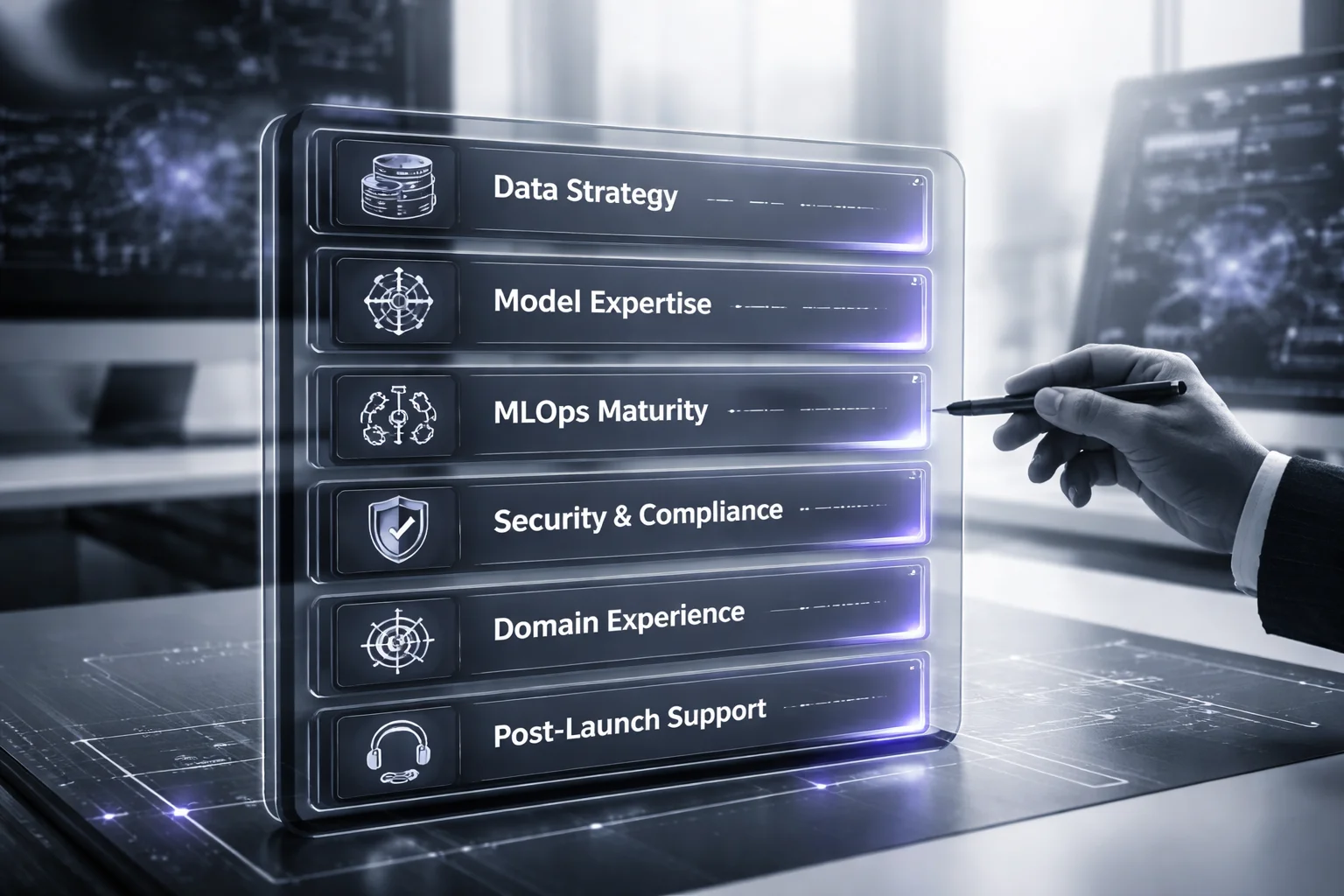
How to Evaluate an AI Model Training Company
Everybody says the same thing first: watch the demo, meet the team, see if the vision feels right. Sure. Fine. Demos have their place.
But I'd argue that's the part buyers overweight, and it keeps burning people.
I’ve seen it happen. A vendor walks through a glossy prototype in 27 minutes, everybody on the call smiles, someone says “this looks promising,” and then four months later the real conversation starts — why nobody asked about data labeling, drift monitoring, rollback, compliance review, or who owns the mess once the model slips in production.
That’s not a procurement problem. It’s a questioning problem.
If you’re evaluating an AI model training company, don’t score the performance. Score the parts they’d rather skip past. Use a 1-to-5 rating in every vendor call if you want something simple, but don’t let anyone get away with vague promises or pretty slides. I think examples matter more than decks. Every time.
Security and compliance
This is where a lot of companies still act like it’s 2021 and everyone can just “figure governance out later.” Bad idea.
Itransition pointed to Capgemini research showing that 46% of executives have started adopting open-source AI models from non-US/EU providers. Maybe that’s completely acceptable for your use case. Maybe it creates a legal headache you’ll be paying for next quarter.
Ask where the model came from. Ask how third-party components are reviewed. Ask about privacy controls, residency options, and provenance in plain English. If they can’t answer cleanly, keep them far away from regulated data and core IP. I’m serious. This is how “we’ll sort that out later” turns into counsel on Zoom and a six-figure cleanup.
Data strategy
This is the part people pretend is boring right up until it wrecks everything.
If they’re weak here, I’d end the conversation early. Bad training data doesn’t create a minor issue you patch later. It contaminates all of it — testing, tuning, deployment, support, trust.
Oracle has been repeating this for years because they’re right: weak or biased data creates unreliable outputs and production failures. So skip lazy questions like “How do you handle data?” Ask about data preparation and labeling, dataset versioning, sampling strategy, edge-case capture, and data quality management.
- Score 1: “We’ll work with what you have.”
- Score 3: They can show labeling workflows and QA checks.
- Score 5: They can explain exactly how they improve poor source data before training starts.
A real answer sounds specific: “Your claims dataset only has 2% fraud examples, so we’d rebalance sampling, check label consistency across annotators, and build an edge-case set before training.” That’s useful. That’s someone who’s done this before. Anything softer usually means trouble.
MLOps maturity
A notebook demo isn’t a product. It’s barely a beginning.
This is where plenty of firms selling custom AI model training come apart under pressure. The model works once in an isolated environment. Great. Then month three arrives, performance drops 8%, somebody asks who owns retraining, and suddenly nobody has a clean answer.
Ask how they manage experiments, reproducibility, retraining triggers, drift monitoring, rollback plans, and handoff into your stack. Ask who owns what after launch week. Silence here tells you more than any case study ever will.
Model expertise
You’re not paying for buzzwords or a list of model names said confidently on a sales call.
You’re paying for judgment.
A serious provider of AI model training services should be able to walk through architecture choice, baseline testing, transfer learning, fine-tuning paths, and where feature engineering still matters.
Use invoice extraction as a pressure test. Ask them to compare LLM-based extraction against classic document models. A good team won’t give you one neat answer because there usually isn’t one. Maybe the LLM handles ugly layouts better but gets inconsistent on repeated fields. Maybe the older document pipeline wins on cost and predictability. If they act like one option is obviously right in every case, I wouldn’t trust their judgment much.
Domain experience
A lot of vendors sell “industry expertise” like it’s a badge wall on their homepage. I don’t care about badges that much.
I care whether they’ve seen your kind of failure before.
An AI model fine-tuning company with healthcare experience should already understand annotation disagreement in clinical text. A team selling enterprise AI training services into manufacturing should know defect classes drift over time because production lines change, lighting changes, suppliers change, and reality refuses to stay put.
The best question here is blunt: what usually breaks in our use case during the model training lifecycle? If they know your world, they won’t answer with fluff. They’ll tell you exactly where things go sideways.
Post-launch support
This part gets treated like paperwork when it should be treated like survival planning.
The launch is the starting line.
Your shortlist should include vendors that define support windows, retraining ownership, performance reviews, and escalation paths before anything gets signed. No foggy “shared responsibility.” No hand-waving after go-live.
If you want a cleaner structure for those conversations, Buzzi AI has an AI model training consulting engagement framework.
The funny part is the best machine learning training partner often sounds less polished in sales calls because they keep bringing up failure modes, bad inputs, rollback plans, compliance constraints, label noise, drift alerts. Good. That isn’t negativity. It’s competence.
A vendor can score well in one area and still be wrong for your bottleneck. So no, this isn’t really a checkbox exercise. It’s risk discovery dressed up as vendor evaluation — and if they make all of it sound easy, what are they not telling you?
Match Requirements to the Right AI Training Partner
What actually wrecks an AI project?

Not the kickoff deck. Not the polished demo with the clean UI and the smiling solutions architect. I watched one team sign off on a six-figure engagement because the vendor looked fast, sounded sharp, and made procurement feel safe. Ninety days later, the model still couldn't handle a basic internal routing task, security was asking questions nobody on the vendor side could answer, and the business sponsor started backing away with that familiar line: “maybe we moved too early.”
I've seen versions of that in banks, insurers, SaaS companies, all of it. Same pattern. A shortlist gets built around speed, price, and case studies. Somebody throws in a big-name logo like IBM or Accenture as if brand alone settles the argument. Then three months pass and everyone's pretending they were always worried about rollout risk.
So what wrecks it?
The partner doesn't fit the job. That's it. Expensive isn't the problem. Cheap isn't the problem either. Wrong is the problem.
I think teams still underestimate how much this has shifted in just the last year. Itransition cites IBM data showing 65% of CEOs are prioritizing AI use cases based on ROI. That's a useful correction. This isn't a buzzword beauty pageant anymore. It's a payoff-path decision, and if your CTO is betting budget on something that can't show financial value fast enough, people get nervous in a hurry.
The question I'd ask before talking to any vendor
Where does failure get expensive for you?
If failure means you burn eight weeks and learn something, that's survivable. If failure means you misprice risk, miss fraud patterns, or botch deployment across five internal teams with legal, security, and ops all slowing each other down, that's a different class of pain entirely.
Narrow task. Clear workflow. Stable data. Fine-tuning usually wins.
An AI model fine-tuning company is usually the right move when you need faster gains on a defined task. Support ticket classification. Document routing. Internal search ranking. Workflows that already exist, where nobody is asking the model to invent fresh business logic out of thin air.
This tends to work when your data shape is stable and transfer learning can do most of the heavy lifting without rebuilding from scratch. But don't kid yourself: you still need discipline around data preparation and labeling and data quality management. Skip that part and you'll get junk wrapped in a nice dashboard. I've seen teams ruin a perfectly reasonable fine-tuning effort because 12% of their labels were inconsistent across business units, which sounds small until it's your production output going sideways.
Generic models keep missing how your business really works? Pay for custom development.
Custom AI model training makes sense when off-the-shelf models can't capture your actual operating logic. Pricing engines are a classic case. Fraud detection too. Industrial vision systems. Domain-specific extraction pipelines where the value sits inside ugly edge cases that generic models flatten or ignore.
This is where your machine learning training partner has to cover more of the model training lifecycle: problem framing, feature engineering, baseline comparisons, and evaluation against business outcomes instead of vanity metrics that look good in slides and mean nothing in production.
It costs more. It moves slower. I'd argue sales teams still soft-pedal both facts because “slower” sounds bad on calls. I disagree with that instinct. If a slower build protects margin or reduces operational risk, slower may be exactly what you should buy.
Sometimes model quality isn't even the thing blocking you
Hybrid delivery fits situations where technical success alone won't get you into production. That's common in enterprise work and everybody acts surprised by it every single time. Security review drags on for weeks. Integration effort gets wildly underestimated. Procurement turns weirdly theatrical. Internal handoffs kill momentum because no one owns deployment end to end.
A hybrid setup usually combines modeling specialists with operators who can manage rollout inside enterprise chaos. That's where enterprise AI training services earn their keep — not because they're flashy, but because they reduce the odds that deployment dies in committee after the model already “worked.”
The short version people should've started with
- Choose fine-tuning if speed matters most and the task is narrow.
- Choose custom development if differentiation matters most and generic models fall short.
- Choose a hybrid partner if governance, scale, and cross-team execution matter as much as model quality.
If procurement is about to turn this whole thing into theater — and it happens fast — use Buzzi AI's AI model training consulting engagement framework.
The best partner isn't the one promising everything. It's the one whose limits line up with your priorities. Strange how teams ask that question last instead of first, isn't it?
What to Ask Before You Sign with an AI Model Training Company
Everyone says the same thing first: ask about accuracy. Ask for the demo. Ask how fast they can get you to production. That’s the standard pitch, and sure, it sounds sensible right up until a polished pilot on 200 clean records turns into a six-figure contract by Thursday and nobody in the room has asked who’s cleaning the data or fixing the mess later.

I’d argue that’s the outdated part. Accuracy numbers without process are basically stage props. A founder can talk all day about automation, proprietary methods, and aggressive deployment timelines, but if they can’t show you who touched the data, who verified the labels, and what happens when real inputs get weird, you’re not buying competence. You’re buying confidence.
The missing piece sits in the middle of all this boring operational stuff people love to skip: can they prove, step by step, how they move from raw data to deployment with clear accountability?
That’s the question.
Not the flashy one. The useful one.
If an AI model training company gets slippery when you ask about data preparation and labeling, I’d be nervous fast. Same story if they talk around data quality management like it’s back-office trivia. It isn’t. Weak data is where projects start dying in slow motion. Ask what they do with incomplete records. Ask how they test edge cases. Ask who owns retraining once the model is live. Ask who monitors drift, who approves rollback plans, and who has to answer for the accuracy drop that tends to show up around month three instead of month one.
Month one is easy. Everybody’s still celebrating launch.
Month three is where things get honest. Your input mix shifts, exceptions pile up, and suddenly that model is down 8% because production data doesn’t behave like a neat sample dataset. I’ve seen teams act shocked by that, as if drift were some rare weather event instead of a routine operational problem.
Get annoyingly specific. Who owns the dataset after labeling is finished? How is evaluation handled before release? What does deployment look like in practice, not in a slide deck with arrows and icons? What support do you actually get after go-live: ongoing monitoring, named contacts, scheduled reviews—or just a help email buried in a queue?
Gartner says 57% of organizations aren’t AI-ready. I don’t think that number comes from lack of ambition. I think a lot of it comes from buyers skipping the messy middle because the shiny parts are easier to sell internally. If a vendor can’t walk you through responsibility from raw input to production model without hand-waving, what exactly are you signing for?
The question worth sitting with
The right AI model training company isn't the one with the slickest demo, it's the one that can turn your business problem, data, evaluation standards, and deployment constraints into a system that actually survives contact with production.
So before you sign anything, force specificity. Make vendors show their full model training lifecycle, from data preparation and labeling to model evaluation metrics, MLOps integration, privacy and data governance, and deployment readiness. And watch for the usual nonsense: vague ownership terms, hand-wavy fine-tuning claims, weak data quality management, and no clear answer on what happens after launch when the model drifts or breaks.
If a vendor can't explain how your model will fail, why are you trusting them to build it?
FAQ: AI Model Training Company Guide
What does an AI model training company actually do?
An AI model training company handles the full model training lifecycle, not just the training run itself. That usually includes data preparation and labeling, data quality management, feature engineering, model selection, training, fine-tuning, model evaluation metrics, and deployment readiness. If a vendor only talks about GPUs and model size, that's a red flag.
How do I evaluate an AI model training company before hiring one?
Start with proof, not pitch decks. Ask how they measure success, which model evaluation metrics they use, how they run cross-validation and hyperparameter tuning, and whether they can show results from similar enterprise AI training services. According to a 2026 Gartner report cited by Itransition, 57% of organizations believe their data isn't AI-ready, so a good partner should be brutally clear about data risk from day one.
Can an AI model training company help with data labeling and preparation?
Yes, and honestly, they should. Strong AI model training services usually cover data collection, labeling, annotation guidelines, quality checks, versioning, and dataset cleanup because bad data wrecks model performance fast. Oracle has repeatedly emphasized that poor or biased training data leads to unreliable outputs and production failures.
Is fine-tuning, transfer learning, or prompt tuning better for my use case?
It depends on your data, budget, latency needs, and how much control you need over outputs. Prompt tuning is faster and cheaper for some language tasks, transfer learning works well when you have limited labeled data, and custom AI model training makes sense when off-the-shelf behavior isn't good enough. A serious AI model fine-tuning company should explain the tradeoffs in plain English, not push the most expensive option.
Does an AI model training company provide MLOps and deployment support?
The good ones do, because a trained model that can't survive production is basically a demo. You should expect MLOps integration support like reproducible pipelines, model versioning, monitoring, retraining workflows, and model deployment readiness checks. If handoff ends at a weights file in cloud storage, you're buying trouble.
How do privacy, security, and data governance work with an AI model training company?
You need clear rules for data access, retention, encryption, audit trails, and where training happens, especially for regulated industries. Ask whether the vendor supports private environments, role-based access, SOC 2 compliance, and documented privacy and data governance controls. This matters more than flashy benchmarks if your data includes customer, financial, or health information.
Which evaluation metrics should a vendor use to prove model performance?
There isn't one magic metric, and anyone pretending there is shouldn't be touching your model. The right machine learning training partner should map metrics to the business problem, like precision and recall for fraud detection, F1 for imbalanced classification, BLEU or ROUGE for some language tasks, and task-specific human evaluation for generative systems. They should also compare against a baseline, not just show a single number with no context.
What contract terms should I confirm before starting with an AI model training company?
Get specific about IP ownership, training data rights, SLAs, delivery timelines, acceptance criteria, security obligations, and what happens if the model misses agreed targets. You should also confirm who pays for GPU or compute provisioning, how change requests are handled, and what handoff includes. According to a 2026 IBM survey cited by Itransition, 65% of CEOs are prioritizing AI use cases based on ROI, so your contract should tie work to measurable outcomes, not vague promises.