AI for Vehicle Automation: Clarity First
Most failures in vehicle automation aren't computation problems. They're communication problems. That's the part people hate admitting, because it means the...
Most failures in vehicle automation aren't computation problems. They're communication problems. That's the part people hate admitting, because it means the flashiest AI for vehicle automation can still fail at the exact moment a human needs to understand what the car is doing, why it's doing it, and whether they're supposed to step in.
Look, I've seen teams obsess over perception models and planning stacks while treating driver handoff design like a UI cleanup task. Bad idea. According to the U.S. Department of Transportation's 2024 AI risk whitepaper, hazards show up not just in detection and control, but in human-machine handoff too. This article breaks down six places clarity-first HMI wins, from intent signaling for takeover to state communication patterns that keep mode confusion from turning into a safety problem.
What AI for Vehicle Automation Really Means
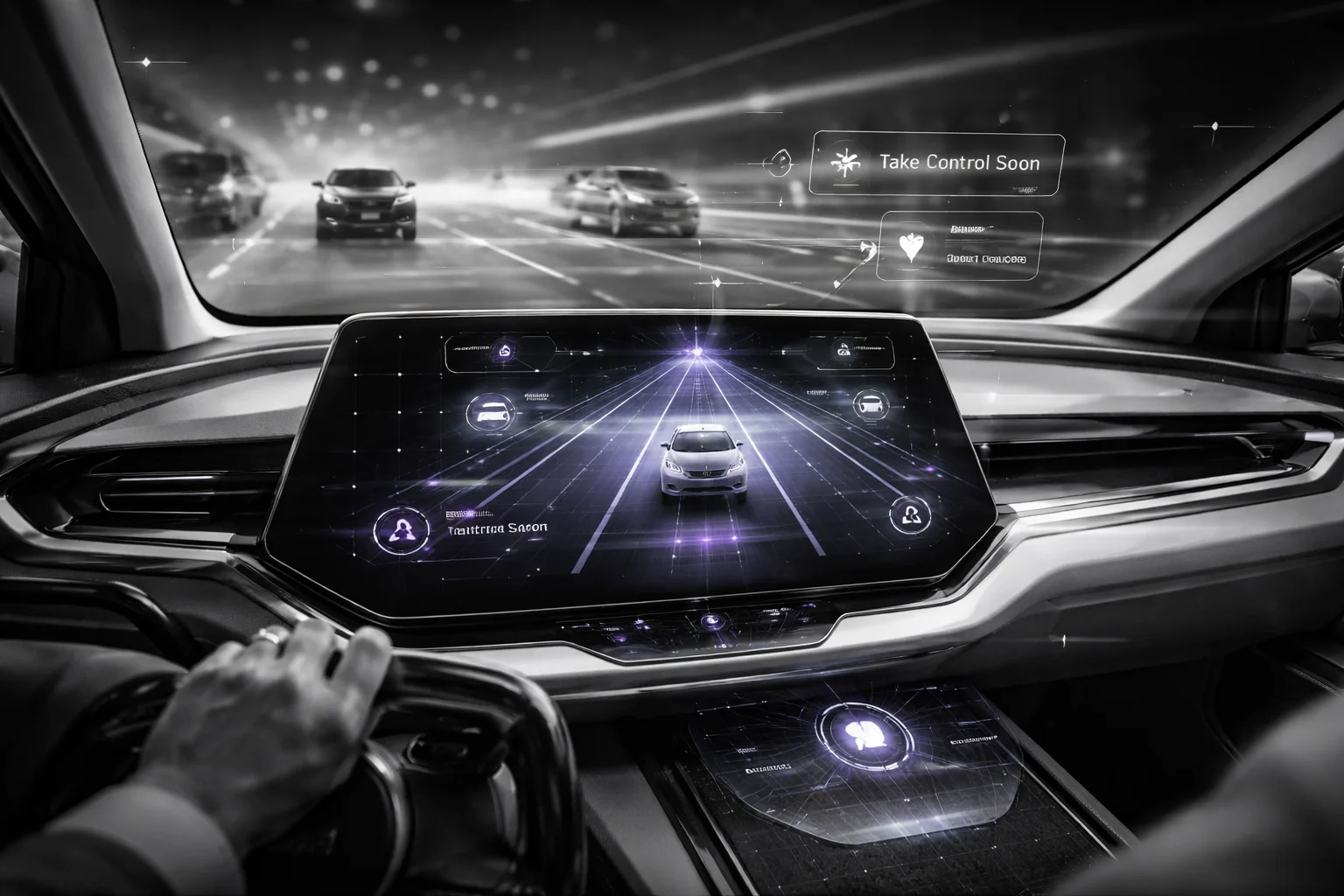
I remember a review where the room was feeling smug for about ten minutes. Big display. Clean lane-centering footage. Bounding boxes snapping around cyclists and orange traffic cones like the system had everything handled. Then the takeover request came in late, the HMI text was vague, and somebody finally asked the question that should've been asked first: does the driver actually understand the mode transition, or are we just hoping they do?
Silence.
I've seen this happen fast. Eight seconds fast. That's enough time for a polished demo to turn into a mess if nobody can tell what the car is doing, what it's about to do next, and when the human is supposed to step in.
That's the real job. Not just lane keeping. Not just object detection. Not just path planning. AI for vehicle automation has to cover control, yes, but also explanation, timing, handoff, and trust under pressure.
I think teams still underrate that because perception looks better on a slide. A benchmark score feels clean. A takeover sequence at 70 mph doesn't. If a Level 2 or Level 3 feature changes state and all the driver gets is something mushy like “attention needed,” that's not communication. That's dumping interpretation work on a stressed human at highway speed.
The research backs this up. A 2025 Springer Nature workshop-based study with 21 expert academics framed vehicle automation as more than control alone; it also includes human-vehicle interaction and system management. I'd argue that's where the real safety fight is. Driver handoff design. Intent signaling for takeover. Clear vehicle automation communication. Miss those and the flashy autonomy footage starts to feel a little fake.
The market already changed too, and not in some abstract way. According to Ekho Blog’s coverage of a 2025 survey, 68.4% of shoppers who used AI during vehicle research used ChatGPT. Before they ever sit in the driver's seat, they're already getting used to software that answers in plain English and explains tradeoffs without sounding like an internal engineering memo. Then they get into a car and the interface talks in clipped labels and color hints like it's doing them a favor.
No wonder people get confused.
A clarity-first HMI for AVs should make state changes obvious without forcing drivers to decode vague terms or guess what a yellow icon means this time. Say what mode the system is in. Say what's changing. Say what happens next. If takeover is coming, signal intent early enough that the driver can actually recover context instead of scrambling after the fact.
The DMS matters here too. It shouldn't just act like a black box with opinions, logging inattentiveness after things have already gone sideways. It should support takeover readiness before they do. That's a different standard.
Treat clarity like braking distance or sensor redundancy. Same category. Same seriousness. Users trust systems that state intent early and plainly, and you can see that same design truth in totally different interfaces too, including this piece on Ai Phone Assistant For Enterprise Design Playbook.
Why Communication Matters in Vehicle Automation AI
The weird part wasn't the driving. It was the chime.
I was in a demo where the vehicle did almost everything right until it didn't. Clean lane keeping. Smooth behavior. Then an edge case hit, the automation state shifted, a tiny on-screen message appeared, and the audio cue sounded like Outlook reminding you about a 2 p.m. meeting. I remember glancing around and silently counting—one, two, three. By then, the room had gone tense. Engineers were staring at the display. Product leads were reading each other's faces. Nobody could say, in plain English, what the system thought was happening, whether automation was still engaged, or whether the driver needed to grab control immediately.
That's not some minor polish problem. I'd argue that's the whole problem showing up early.
A lot of vehicle automation teams get hypnotized by the sexy parts: perception, prediction, planning. Sure, those matter, and they're easy to put on a conference slide. The World Economic Forum said in its 2025 report that end-to-end AI models are replacing older rule-based setups by pulling those functions into one learned system. Fine. Impressive architecture. Still useless in the moment that matters if a tired driver at 70 mph can't tell whether the car is driving, hesitating, degrading, or handing responsibility back.
You can call that UX if you want. I wouldn't. If the driver can't interpret system state, intended action, and hard limits fast enough to act safely, you've got a communication failure before you've got an autonomy failure.
And yes, this lands in the boardroom too. Muddy state communication kills takeover readiness fast. A driver monitoring system can tell you whether someone's eyes were up or whether their hands were near the wheel. It can't go back in time and repair a vague message. Once people are under pressure asking basic questions—Is automation on? Is it weakening? Am I supervising or actively driving? Do I need to take control right now?—you've already burned seconds you don't get back.
People hate guessing around safety. They stop trusting the feature. Then they stop using it. I've seen this pattern before: expensive automation package, flashy launch video, then six months later it's basically showroom theater because owners don't feel sure enough to rely on it.
The market's moving faster than some teams realize. Ekho Blog reported in 2025, citing Cars.com, that 44% of car shoppers had already used AI-powered tools during the buying process. That's training buyers to expect software that explains itself clearly and behaves in ways they can predict. Put those same people into a vehicle where mode changes feel murky and handoffs feel cryptic, and they'll spot the mismatch instantly.
So here's the part I'd keep taped to every HMI review wall.
Say the current mode plainly. No icon-only guessing games. No soft language trying not to sound alarming. Tell people exactly what mode they're in.
Tell them what's likely next before the window gets tight. Good systems don't wait until the last second to hint at a handoff. They give drivers a head start.
Make takeover intent impossible to miss. Not just louder. Better coordinated. Visuals, wording, timing, audio—they should all deliver one message instead of four half-messages fighting each other.
This isn't even just a car problem. Voice systems taught this lesson years ago. The piece on Voice Assistant For Phone Support Design Framework makes basically the same point from another angle: people stay calmer when a system states status and next steps instead of forcing them to infer everything.
I'd test comprehension as hard as technical performance. After a run, ask drivers what mode they think they were in. Ask what they thought would happen next. Ask how much time they believed they had before acting on a takeover request. I've watched teams sit through ten flawless route replays and miss the real issue because nobody asked those three questions out loud.
If driver answers drift from reality, trust is already cracking.
And trust decides whether AI for vehicle automation gets adopted or just quietly eats ROI while everyone insists the demo went great—so what exactly are your drivers hearing when your system changes its mind?
Common Mistakes in Driver Handoff Design
The hottest bad take in automated driving?
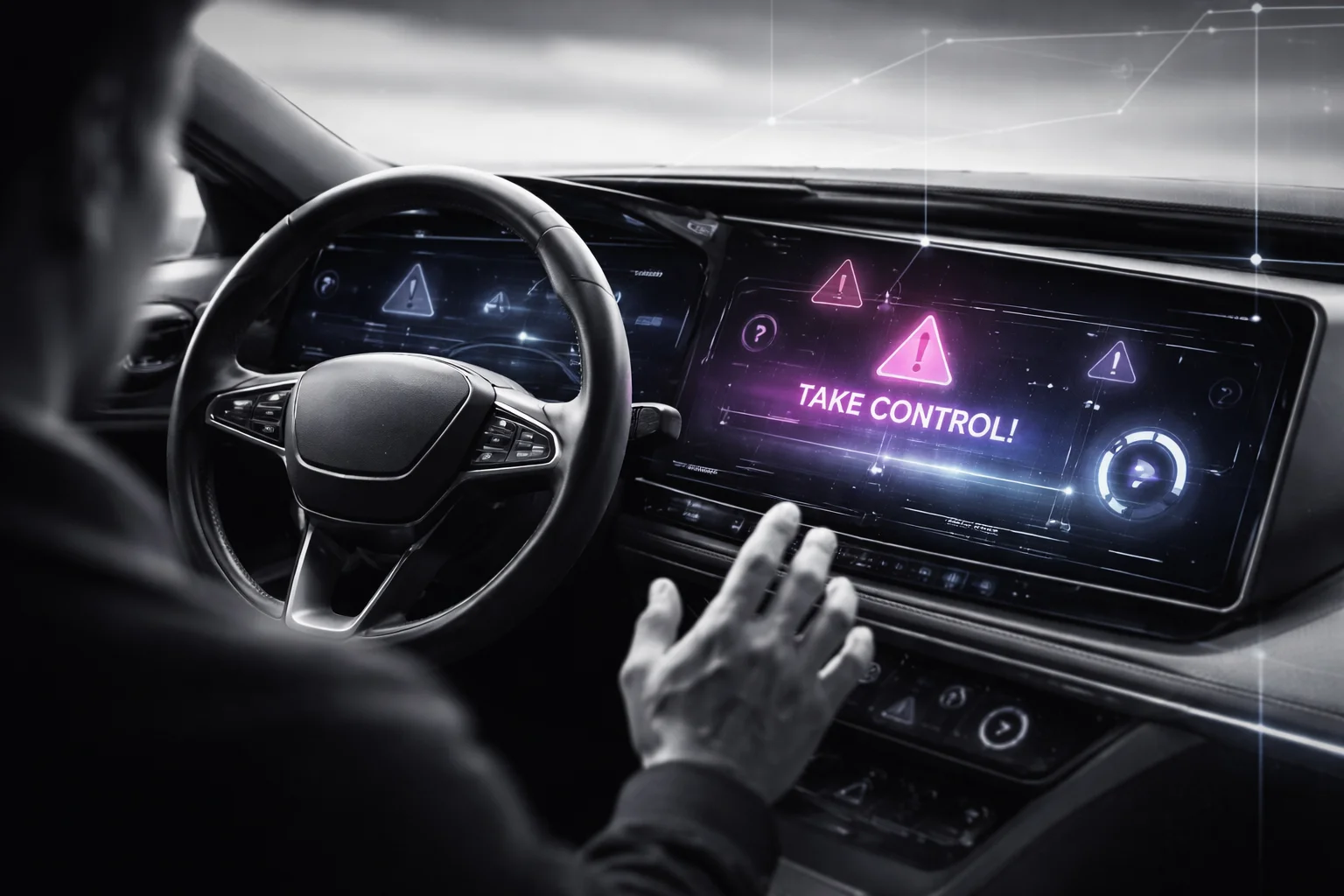
People keep acting like the first thing to break is perception. Missed cyclist. Bad lane read. Rain at dusk. Sure, those matter. Waymo, Tesla, Mercedes — all of them get picked apart on whether the car can interpret the road. I get why. It's visible. It's dramatic. It's easy to point at a sensor stack and say that's where the real work is.
I don't buy that as the main failure point. I think teams spend months arguing about detection thresholds and edge cases, then phone in the exact moment the machine needs the human back. That's where it gets ugly fast. I've seen handoff designs that amounted to one chime, one glowing icon, and a tiny “take control” prompt that looked like it belonged in a printer settings menu.
That's not some rare design slip. That's the system failing where it matters most.
A 2025 Springer Nature review laid this out pretty plainly: autonomous vehicles are layered systems with localisation, perception, planning, control, human-vehicle interaction, and system management. Human-vehicle interaction sits in the stack. Right there with the rest of it. Not decorative. Not something you clean up late because sprint 14 finally has room.
That changes the argument. Hidden mode changes aren't a visual nitpick. Vague alerts aren't branding problems with better colors. Sloppy state communication isn't polish debt. It's broken system behavior wearing a UI costume.
The worst version is vague urgency. “Please take control” sounds polite. It also tells the driver almost nothing useful. Why now? Do I have 8 seconds or 2? Am I steering? Braking? Both? If takeover readiness matters — and obviously it does — the interface has to answer three things instantly: what changed, how urgent it is, and what you need me to do right now.
Picture a real scene instead of an abstract requirement doc. You're on I-280 doing 65 mph in light rain. Construction barrels have chewed up the lane markings. The car gives one soft chime and drops a dashboard message with no reason attached. No countdown. No explanation. No action cue beyond “take control.” That's not assistance. That's confusion moving nearly 100 feet per second.
Drivers don't freeze because humans are irrational idiots. They freeze because generic warnings force interpretation at exactly the wrong moment.
Inconsistent behavior makes it worse. One road condition gets loud audio plus bright visual escalation. Another risk in the same category gets a tiny dashboard label and almost no urgency signal at all. Same class of problem, different communication style. How's anyone supposed to build a reliable mental model from that? They won't. They'll guess.
The driver monitoring system doesn't magically patch this over either. A DMS can tell you someone's eyes are open or pointed forward. Fine. Useful, even. It still can't repair bad automation communication after the fact. If the vehicle explained itself poorly, knowing the driver was technically looking ahead doesn't solve much.
Branding sneaks in and poisons this too. Overconfident language teaches trust before competence earns it. “Autopilot-like” framing pushes people toward assumptions that may collapse under pressure, especially during handoff moments when wording suddenly matters more than marketing ever admits.
The market's already telling automakers this matters beyond engineering circles. Ekho Blog cited Cars.com reporting that 97% of car shoppers in 2025 said AI will influence purchase decisions going forward. Ninety-seven percent isn't background noise. Buyers are judging software behavior now — not just horsepower or leather quality — and they notice whether a car explains itself clearly when things get weird.
So what do you do differently? Start with explicit mode status all the time, not only when something breaks bad enough to trigger panic sounds. Make intent signaling aggressive during takeover: what mode I'm in, what's changing, why it's changing, how urgent this is, what exact action you need from me now.
Don't make drivers decode theater lighting and soft tones like they're trapped in an escape room designed by an HMI committee.
The same trust rule shows up outside cars too. This piece on Relationship Preserving Ai For Sales Automation lands on basically the same truth: confidence without clarity burns trust fast.
That's the part people miss. The handoff isn't a side quest after autonomy does the hard part. The handoff is where your product reveals whether it ever understood the human at all.
State Communication Patterns That Keep Drivers Oriented
Why do drivers bail on automation even when the sensing stack looks great in the demo deck?
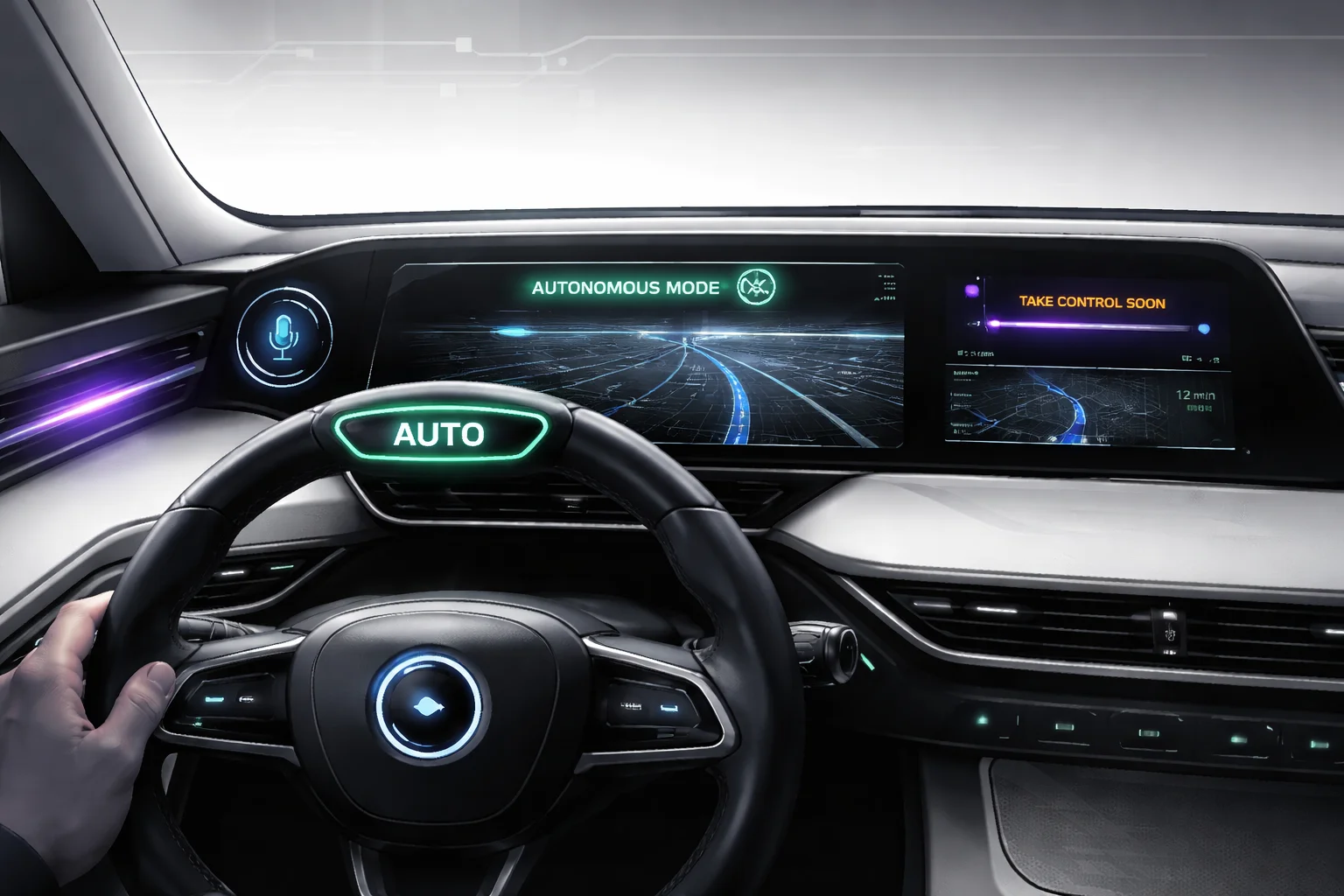
People love to say the hard part of AI for vehicle automation lives in planning, perception, and control. Smarter models. Better detection. Faster decisions. I've heard that pitch in too many conference rooms, usually right before somebody waves past the screen the driver actually has to read.
The driver never sees your architecture diagram. They get a banner, a chime, maybe a steering-wheel light, and roughly a second to decide whether the car is driving, assisting, hesitating, or handing the mess back to them. That's it. One glance at 65 mph.
The U.S. Department of Transportation said as much in its 2024 AI risk whitepaper. It didn't just warn about localization, object detection, planning, and control. It also flagged human-machine handoff when AI-enabled vehicle functions fail or are poorly designed. Handoff made the list because confusion during state changes is part of the hazard, not some side issue for the HMI team to clean up later.
Here's the answer: most systems don't have a model problem first. They have a state communication problem first.
But that's where teams get sloppy, because they treat state like branding. Tiny icon in the corner. A symbol nobody can decode under pressure. Blue this quarter, teal after the next refresh. I think that's backwards. Nobody in rain and traffic wants to interpret hieroglyphics.
What actually works is layered state communication: one persistent state indicator, one urgency channel, and one plain-language summary. Most interfaces quit after the first piece and then act surprised when drivers don't trust what they're seeing.
Start with persistence. Same place every time. Same words every time. Not “Assist On” on Monday and some abstract badge on Tuesday. Use labels a person can read fast: Manual, Assisted Steering, Automated Driving Active, Take Control Now. That's how a clarity-first HMI for AVs keeps people oriented: repetition beats cleverness.
Color can help too, if you don't mess with the meaning. Green for active control. Blue for supervised assist. Amber for degraded capability or pending takeover readiness checks. Red for immediate action. Then keep those meanings locked across the instrument cluster, steering-wheel indicators, center display, and audio confirmations. Same color. Same meaning. Everywhere.
A lot of systems still blow it in uncertainty handling. They stay quiet until it's time to throw a takeover request like a grenade. Bad move. If lane markings disappear in heavy rain or object classification confidence drops near a construction merge — which is exactly the kind of ugly edge case that shows up around 6:40 p.m. on a Thursday commute outside Houston or Phoenix — say so before things get dire: Automation active, sensor confidence reduced, prepare to drive. That's better vehicle automation communication.
The status line should answer three questions at once: what's happening now, why it changed, what happens next. For example: Automated driving active. Construction zone ahead. Driver supervision required. That's real intent signaling for takeover. Not decorative copywriting.
DMS matters here too. If the driver monitoring system catches low attention, escalation can't feel random or moody. Match it to urgency: first confirmation, then warning, then directive audio. Not every beep should sound like disaster; not every actual risk deserves another soft little nudge.
This isn't safety theater either. The money shows up fast when people understand the system quickly enough to use it correctly. A 2026 Motive guide says fleets with more than 1,000 vehicles can recoup their investment in as little as 2.5 months. You don't get that from clever models alone. You get it from systems drivers can read without guessing.
If you want a parallel outside vehicles, this piece on Voice Assistant For Phone Support Design Framework lands on the same point: clear status plus next-step guidance beats vague polish every time.
So sure, build better automation. If the driver still can't tell what mode they're in fast enough to act correctly, what did you really improve?
Intent Signaling Design for Safe Takeover Readiness
Everybody loves the easy headline: five months. That's the average payback period respondents reported in Motive's 2026 guide, and sure, I understand why that number spreads through boardrooms like free coffee. Fast ROI sounds clean. Fast ROI also hides a mess.
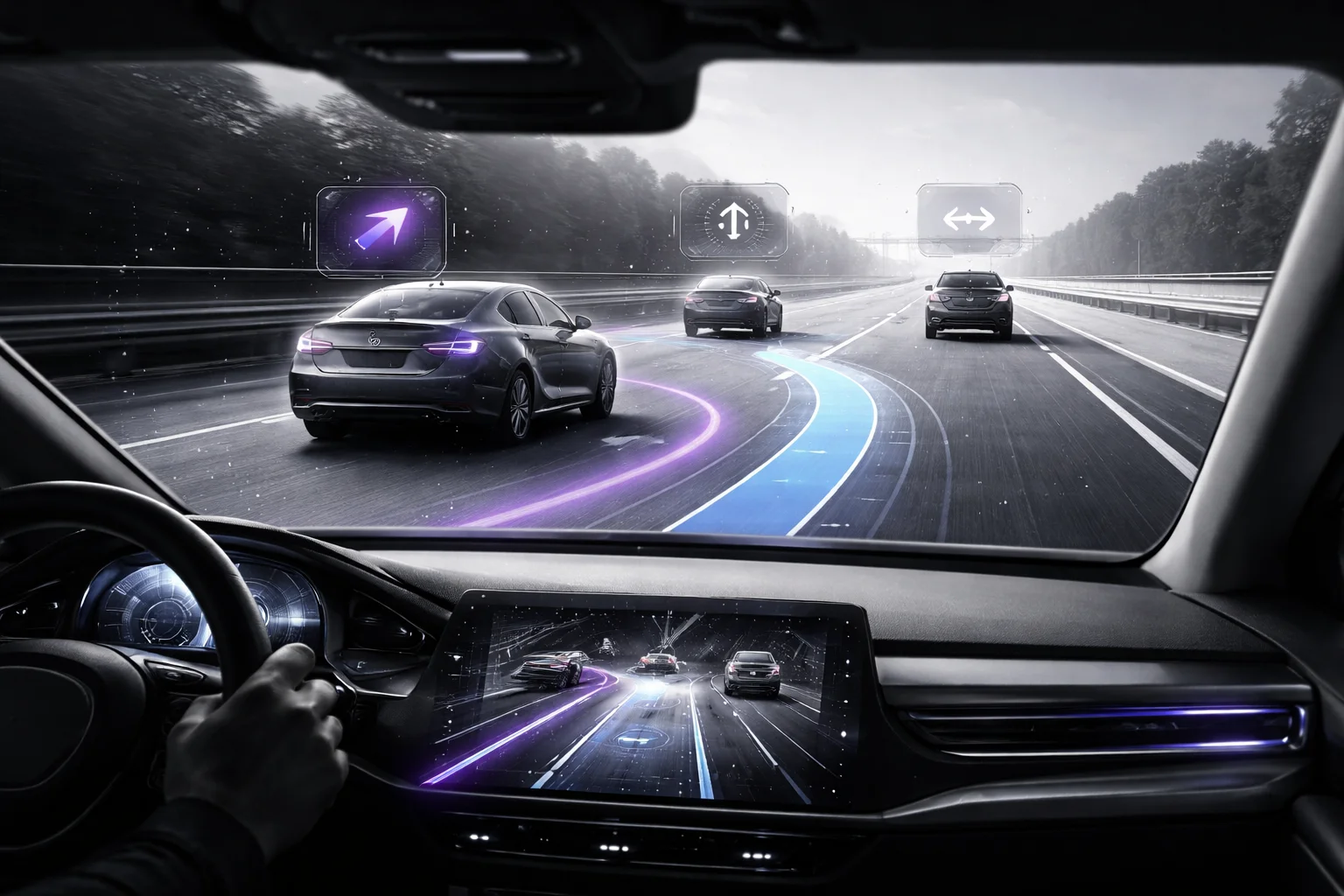
I've seen what happens next. A team pulls up capability slides, argues about autonomy tiers, books another demo, and leaves the handoff experience flimsy enough that a driver gets caught off guard by a lane change, a hard slowdown, or a disengage right when traffic gets ugly. That's not a product win. That's a design failure wearing a nice spreadsheet.
People talk about what the system can do. Old framing. The missing piece is what the system says before it does anything.
I think this matters more than another polished autonomy video on a closed test track.
AI for vehicle automation should announce intent early. Not after the wheel starts moving. Not at the exact moment the software decides it's out of depth. Before. Enough time for a human being to form a picture of what's coming.
The bad version waits until execution: taking control, merge in progress, manual takeover required. That's basically narration after the fact. The useful version gives the driver something actionable: preparing to merge left in 3 seconds, slowing for stopped traffic ahead, route confidence reduced, be ready to take over.
Same event. Different wording. Huge gap in outcome. Reaction is sloppy under pressure. Preparation gives you a fighting chance.
NHTSA hasn't been subtle about this. Drivers need a clear understanding of automation mode and system status because mode-awareness failures show up when people don't realize automation has disengaged. You can see why one tiny icon or a soft chime buried in the HMI doesn't cut it. If an AV is about to reroute around construction, brake hard to yield, change lanes, or issue a takeover request, timing isn't decoration. Timing is the whole thing.
The pattern I trust is simple: preview, confirm, execute.
Preview intent with plain language and timing: Lane change right likely in 4 seconds. Confirm once commitment is high: Changing lanes right now. Execute with cues that agree with each other: visual path cue, audio prompt, then haptic reinforcement if urgency rises.
A one-channel setup breaks fast. Visual banner for state. Audio cue for urgency. Steering-wheel or seat vibration when escalation matters. Three channels, one message. That's how clarity survives noise, bright sun, road vibration, and the driver who glanced down just long enough to miss the first warning.
The driver monitoring system should shape that escalation around attention state. Eyes off road for even two seconds? That's plenty of time to miss a short lead-time alert at highway speed. At 65 mph, two seconds is roughly 190 feet gone. Earlier signaling can still help there. Last-second signaling usually can't.
This is why good driver handoff design beats flashy demos every time. Drivers shouldn't be decoding surprises while the car is already moving into them. They should be predicting vehicle behavior before the event fully unfolds.
The same idea shows up outside vehicles. This piece on Ai Phone Assistant For Enterprise Design Playbook lands in the same place: systems earn trust by stating next steps before users feel stranded.
Do the part teams keep skipping. Make intent visible early. Make it multimodal. Make takeover readiness measurable. If your system can't clearly say what it's about to do next—and when—why would any sane person trust it?
How to Build Clarity-Focused AI for Vehicle Automation
What actually fails first in a vehicle automation demo? Not the thing people love to point at. Not the planner trace on the big monitor. Not the glossy perception overlay with tidy little boxes hugging every sedan and traffic cone.
I've sat in those reviews. Someone from controls is proud, and fair enough. Someone from perception has a slide with confidence scores. Somebody else is already talking about the next investor demo. Then a takeover request lands at 70 mph in rain, and the room gets weirdly quiet because six smart people are suddenly arguing over what to call the exact same moment.
Tesla, Waymo, Mercedes, GM Cruise before it got dragged through headlines in late 2023—pick your favorite company and the pattern still shows up. Capability gets all the oxygen. Lane keeping looks smooth. Path planning looks sharp. Object classification looks clean on a giant screen. Then the handoff happens, the driver hesitates for three seconds that feel like thirty, and everybody has to face the part they avoided: nobody agreed on what the human was supposed to understand.
One state model. Or honestly, don't bother.
That's the answer. I think this is where most teams lose the plot. They don't have an autonomy problem first. They have a language problem that spreads into safety, validation, UI copy, driver monitoring behavior, and ops until nobody's even arguing about the same system anymore.
I've seen a shared prototype branch drift in under three weeks. Day one: engineering labels a mode "assisted." A week later UX changes it to "active support" because it sounds friendlier on-screen. Then marketing wants "smart drive" for a launch deck because it tests better with nontechnical audiences. Same car. Same logic underneath. Three names already. Bad sign.
No aliases. None. Your product team, software team, validation team, safety team, and operations team should all use one taxonomy with the exact same words every time:
- Control states: manual, assisted, automated active, degraded automation, minimum risk maneuver
- Driver states: attentive, distracted, unavailable, takeover ready
- System confidence states: normal, reduced sensing confidence, route uncertainty, fallback required
Your AV stack should reference those definitions. Your driver monitoring system should too. The HMI copy has to match them exactly. Same words. Same meaning. Every single time.
The screen comes later
The bigger miss is intent. People obsess over display layouts way too early. I'd argue that's backwards. The first thing to map isn't what color the banner should be or where the icon sits on a cluster display in a design comp.
It's what the vehicle is about to do next.
Is it preparing for a lane change? Slowing for a hazard? Leaving its operational domain in ten seconds? Asking for an immediate takeover right now? Drivers don't just need current mode labels; they need forward intent they can act on before the situation turns ugly.
That's where takeover signaling starts for real: explicit intent labels that force teams to say what happens next in plain language before anyone touches visual polish.
The timing matters more than most auto teams admit out loud. The World Economic Forum's 2025 reporting pointed to end-to-end AI models replacing older rule-based stacks in vehicle automation. That means internal behavior gets harder to inspect from the outside. So no, "trust us, the model knows" isn't good enough anymore. Communication has to get stricter as system internals get murkier. That's not optional now.
If your alert passed but your driver guessed wrong, you failed
This is where bad systems still get praised. The chime fired on schedule. The banner appeared for three seconds. The haptic cue triggered exactly when spec said it should. Great. And if the driver misunderstood all of it?
Then who cares?
The real test is comprehension within seconds: can someone correctly state the current mode, urgency level, and required action right after being prompted? That's the bar.
After every takeover request, ask blunt questions:
- What mode were you in?
- Why did the takeover request happen?
- How much time did you think you had?
If those answers come back fuzzy, delayed, or wrong, your handoff design isn't clear yet. Doesn't matter how pretty it looked pinned on a wall in studio lighting.
Then ruin the conditions on purpose
Calm-lab wins are cheap. I've watched teams celebrate a clean run indoors with perfect audio levels and no distractions like they'd solved clarity forever. They hadn't solved anything useful yet.
A clarity-first HMI has to survive glare hitting glass at 4:30 p.m., road noise leaking through bad insulation, fatigue after 40 minutes of passive monitoring, slow attention recovery, multitasking, and distraction events flagged by DMS that don't wait politely for a user to refocus.
Test degraded visibility. Add competing audio sources. Add cognitive load tasks; even something as simple as backward counting by sevens will expose confusion fast. Test while sensing confidence drops or route certainty gets shaky. If clarity only holds up in ideal conditions, it doesn't hold up at all.
There's another reason this matters now: users are already being trained by other AI systems to expect plain explanations before they commit money or action. Ekho Blog's 2026 reporting said 30% of buyers used AI tools during vehicle research. That expectation doesn't disappear once they're inside the car; if anything, it gets harsher when you're asking them to take control back at speed.
If you want a cross-domain example of structured communication under pressure, read Ai Phone Assistant For Enterprise Design Playbook. State first. Action second. Cars still treat that like some radical idea sometimes. Why?
The bottom line
AI for vehicle automation only works in the real world when the system makes its state, limits, and next move obvious enough for a human to understand in time.
If you're building this stuff, audit every automation mode transition, takeover request, and intent signaling cue like it's a safety feature, because it is. Watch for gaps between what the model knows, what the HMI shows, and what the driver monitoring system assumes about takeover readiness. And don't let a technically impressive stack hide weak vehicle automation communication or sloppy driver handoff design.
Clarity is the safety system your AI can't afford to fake.
FAQ: AI for Vehicle Automation
What does AI for vehicle automation actually do?
AI for vehicle automation helps a vehicle perceive its surroundings, predict what other road users might do, plan a response, and control steering, braking, or acceleration within defined limits. According to the World Economic Forum’s 2025 report, end-to-end AI models are replacing many rule-based systems by combining perception, prediction, and planning into one stack. That sounds impressive, but it only works safely if the system also tells the driver what it’s doing and what it needs next.
How does communication affect driver handoff in vehicle automation?
Communication is the difference between a clean takeover request and a confused human grabbing the wheel half a second too late. NHTSA guidance stresses that drivers need clear awareness of automation mode and status, because mode-awareness failures happen when people don’t realize the system has disengaged. If your vehicle automation communication is vague, your handoff design is already broken.
Why do intent signals matter for safe takeover readiness?
Intent signaling tells the driver what the system is about to do before the situation turns urgent. That might include messages like “slowing for lane blockage” or “driver takeover needed in 8 seconds,” paired with visual, audio, and haptic cues. Good intent signaling for takeover reduces surprise, improves situational awareness, and gives the driver time to rebuild a mental model of the road scene.
What are common mistakes in driver handoff design for autonomous vehicles?
The big ones are late alerts, unclear wording, too many competing signals, and no explanation of why the takeover request is happening. The U.S. Department of Transportation’s 2024 AI risk whitepaper warns that poorly designed human-machine handoff can create hazards even when perception and planning are working as intended. Look, if the driver has to guess whether the AV is active, failing, or waiting, the HMI has already lost.
How should an AI system communicate automation status during mode transitions?
It should show mode, capability, confidence, and next expected human action in plain language. A clarity-first HMI for AVs usually combines persistent state labels, color-coded mode indicators, countdown timing for takeover request windows, and a short reason for the transition. State communication patterns work best when they stay consistent across engage, active, degraded, and disengaged states.
Does driver monitoring help with automation mode transitions?
Yes, a driver monitoring system (DMS) can make automation mode transitions smarter by checking gaze, head pose, attention, and readiness before escalating a takeover request. If the system sees the driver is distracted or drowsy, it can change timing, increase alert intensity, or move toward a minimum-risk maneuver. That’s not just convenience, it’s risk mitigation in a safety-critical interaction design.
What timing and latency requirements matter most for takeover request effectiveness?
The critical issue is whether the driver gets enough time to perceive the alert, understand the context, and act before the situation collapses. Timing has to account for sensing latency, decision latency, HMI delivery latency, and human response time, not just when the software decides to issue a takeover request. Honestly, a fast alert that arrives too late is still a bad alert.
How do you validate driver handoff and communication patterns in real-world testing?
You test for takeover time, takeover quality, mode awareness, trust calibration, and error rates across simulators, closed tracks, and live-road pilots. According to a 2025 Springer Nature workshop-based study with 21 expert academics, autonomous vehicle systems span multiple layers, including human-vehicle interaction and system management, so validation can’t stop at perception and control. You need to measure whether people actually understand the system state under stress, not whether the UI looked clean in a demo.