AI for Logistics Solutions That Handle Exceptions
Most logistics teams don't have an automation problem. They have an exception problem dressed up as automation. And it's expensive. According to AVI Logistics,...
Most logistics teams don't have an automation problem. They have an exception problem dressed up as automation. And it's expensive. According to AVI Logistics, 70% of exception handling is still reactive, not predictive, and the average shipping exception takes 4 to 6 hours to resolve. I keep coming back to that because it explains why so many polished dashboards still fail under pressure.
That's where AI for logistics exception handling stops being a nice demo and starts becoming operating infrastructure. Not just alerting. Decisioning. Triage. Fallbacks. Human escalation when the model shouldn't guess. In this article, I'll show you what actually works, where logistics AI for exceptions breaks, and how to design systems that hold up when the network gets weird.
What AI for Logistics Solutions Really Means
I watched a team wire up automation for shipment alerts once, and for about two days it looked brilliant. Every event had a rule. Every rule had an action. Then a weather delay hit, a customs hold landed on the same lane, scans started coming in out of order, and the ops lead had 186 alerts open before lunch. That's the mistake: building logistics systems as if the messy part is rare.
AIintheChain put a clean number on it: one logistics AI model filtered out 70% of low-risk alerts and only pushed up the high-impact ones. That's the job. Not making an already tidy workflow 8% faster. Not dressing up old rules with new branding. It's keeping your team from getting buried under junk signals.
People love to lump this in with automation. I don't. Generic automation says: if X happens, do Y. Great for invoice matching, label printing, routine status updates. Logistics doesn't behave that politely. It runs on missed pickups, weather swings, customs holds, bad scans, partial inventory, and route plans that looked smart at 8:00 a.m. and embarrassing by 10:15.
The middle of this is where most buyers miss it: the problem isn't just volume. It's exception density. Actually, even that can undersell it. High throughput can make a weak operation look healthy right up until something odd happens and every hidden crack shows at once.
AJOT reported in its 2026 logistics tech trends coverage that agentic systems are being pushed to watch capacity, flag coverage risk, and manage exceptions without waiting for someone to kick off the process manually. That's not basic automation anymore. That's real-time decisioning: event-driven architecture, anomaly detection across shipment events, and forecasting under uncertainty instead of pretending the original plan will survive first contact with reality.
You see the same thing in quieter places too. BCG reported that DHL Supply Chain has scaled AI to clean, sort, and analyze customer-submitted data so engineers can design solutions faster. Sounds boring. It isn't. If incoming data is late, incomplete, or messy, your exception management falls apart early. Same for AI route optimization under disruptions — bad inputs kill it before it gets a chance to help.
So here's the framework I'd use.
First: find where exceptions stack up. Not where dashboards look red in general — where work actually piles onto people.
Second: name who handles those cases now. Dispatcher? Customer service? Warehouse lead? Someone always owns the mess, even if nobody wrote it down.
Third: split decisions by speed and judgment. Some calls need machine-speed triage. Some need a human because the cost of being wrong is too high.
Fourth: test failure modes before production does it for you. I'd argue this matters more than any demo you'll see in a sales cycle.
That's what AI for logistics solutions really means to me: systems that stay useful after routine breaks, teams that know their automation failure modes before they get exposed live, and operations that treat high-rate logistics AI design like discipline instead of theater.
If you're trying to evaluate this space seriously, start there. Map the exceptions, map the owners, map the decision types. If you need an entry point, AI Discovery for logistics use cases is usually the right first step — but are you solving noise, or just automating how fast it reaches your team?
Why Logistics AI Fails When Exceptions Rise
Everybody’s saying it now: logistics AI is finally useful. And sure, that’s not just vendor chest-thumping. Inbound Logistics points to real work these systems can do—exception triage, weather response, invoice checks, route changes on the fly. That part is real.

It’s just not the whole story.
The pitch usually assumes a network that’s mostly behaving. A missed scan here. A late truck there. Maybe one handoff gets messy and ops cleans it up. Fine. The demo still looks good. The dashboard still glows green.
Then 2:17 p.m. hits.
A customs hold lands in Rotterdam. Two warehouse doors go down in New Jersey. The EDI feed arrives three hours late. Now the system that looked clever in a steady-state flow starts making thin guesses off stale inputs, and the problem isn’t only accuracy. The bigger mess is operational: the model recommends something, the team can’t act on it in time, and the value dies in that ugly gap between prediction and response.
I’d argue that’s the only test that matters. AI for logistics exception handling either works when exceptions pile up or it doesn’t work.
People love to blame the model first. I get it. Sometimes the model really is bad. But a lot of logistics automation failure modes come from a duller problem nobody wants to put on a keynote slide: companies bolt AI onto batch-based systems that were never designed for event-driven architecture or real-time decisioning. If your system learns about a disruption hours after it happened, calling it real-time disruption management is nonsense.
The spending numbers make this even stranger. AJOT citing Gartner says supply chain management software with agentic AI is expected to jump from under $2 billion in 2025 to $53 billion by 2030. Great board-slide material. Also a good reason to get nervous, because operators don’t keep trusting alerts that arrive late, fire constantly, or tell them nothing useful.
You know what happens next. Dispatchers pull work back into spreadsheets. Someone starts running coordination through chat threads again—usually by day three of a rough week, if we’re being honest. Leadership sees software costs climb while service still feels shaky.
The missing piece isn’t sexy: build for abnormal operations first.
That means logistics AI for exceptions should start with anomaly detection, tolerance for bad data, and forecasting under uncertainty. First, not later. Then those signals have to plug into response workflows people can actually use while things are going sideways, not after the postmortem.
A concrete example helps. According to AIintheChain, a global logistics provider cut last-minute premium freight costs by 18% by using machine learning to anticipate customs clearance delays. That wasn’t magic. It was earlier warning tied directly to action.
So no, the problem isn’t that logistics AI can’t do useful work. It can. The outdated idea is treating disruptions like edge cases when plenty of networks already live in exception mode most days of the week. If that’s still how your operation thinks, that’s probably the first thing to fix with workflow process automation for logistics operations. Because once exceptions stop being rare, what do you think a brittle system does besides get expensive?
Logistics Exception Density: The Design Constraint
What actually breaks a logistics AI system?
Most teams will tell you it’s the model. Bad forecast. Weak routing logic. Wrong confidence score. Nice, tidy answer. Also incomplete.
Picture the shift nobody remembers because it looked like every other shift. 4:17 a.m. A planner opens the screen and sees a missed scan on one load, a delivery appointment moved by two hours on another, port congestion stacking up, rain crossing a regional lane, and a labor disruption rumor floating around before anyone can confirm it. Same operating window. Same team. I’ve seen people still label that an “exception case,” which is wild to me.
It isn’t exceptional. It’s freight.
That’s the answer. Sort of.
AI for logistics exception handling doesn’t fail because reality is messy once in a while. It fails because reality is messy all the time, and the system was designed for the clean version of operations nobody actually gets. I think that’s the core miss. The design target shouldn’t be the average scenario. It should be exception density—what happens when missed scans, appointment changes, port congestion, labor actions, and weather shocks pile onto each other in the same hour. In freight, that’s not edge behavior. That’s Tuesday.
But people still build for calm lanes and then act shocked when the thing folds under pressure.
The numbers aren’t subtle. AVI Logistics / Intellihuman.ai says 70% of exception handling is still reactive instead of predictive. IBM says the uglier part out loud in its supply chain AI analysis: if data arrives late, conflicts with other feeds, or shows up half-finished, the output won’t be useful, as explained here. A lot of teams blame “the AI” for what’s really a timing problem wearing a model-failure costume.
That changes how thresholds should work.
In a low-disruption environment, sure, automate more. Tighten confidence bands. Let more decisions clear without human review. In high-rate logistics AI design, that same move can wreck your day fast. If confidence drops because event feeds are late or disagree with each other, the system can’t keep marching forward like nothing happened. It needs fallback logic that fails safely instead of confidently doing something dumb.
Wait. Ask for another signal. Hand it to a planner. Recompute with tighter constraints.
That’s why logistics AI for exceptions starts to look less like dashboard software and more like control systems engineering. You need event-driven architecture because state changes quickly and often without warning. You need anomaly detection because bad inputs rarely announce themselves nicely. You need real-time decisioning that includes one unfashionable skill: knowing when not to automate at all.
Pharma shows this clearly. According to AIintheChain, one company improved OTIF by 15% without adding buffer stock by combining AI with outside signals like weather, strikes, and port conditions. That’s forecasting under uncertainty done right. Not prediction as theater. Prediction tied to action thresholds people can use at 6:02 a.m., before the first escalation call turns into six more.
I’d argue most teams tune models too early and escalation paths too late.
Build the handoff rules first. Define low confidence in operational terms, not data science poetry. Decide which disruptions require human review and which should trigger automated replanning in predictive analytics forecasting for logistics planning. If two feeds disagree for more than 15 minutes, what happens? If weather risk spikes but scan data is stale, who owns the call?
The best systems don’t automate the most.
They hesitate on purpose. Does yours know when to stop itself?
High-Rate Design Methodology for Logistics AI
$84.76 billion. That's the annual sales growth ResearchAndMarkets projected for logistics AI solutions by 2029, quoted by Yahoo Finance. Big number. I still flinch a little when I see projections like that, because the market can explode while actual deployments still break on the same old boring stuff: late feeds, vague ownership, bad operating rules.

I've watched teams get hypnotized by model scores and miss the obvious. One group spent weeks tuning late-shipment logic. Looked great in testing. In live operations, dead on arrival. The warehouse lead had already made the call manually, the carrier had already moved, and the event feed showed up too late to matter. That's not an AI problem. That's design malpractice.
AVI Logistics / Intellihuman.ai puts average shipping-exception resolution at about 4–6 hours via this reference. That's the number I'd put on the wall before writing a line of model code. If your system can't help inside that window, who cares how elegant your prediction score is?
The middle of this gets missed all the time: AI for logistics exception handling should be designed backward from action, not forward from model accuracy. I'd argue that's the whole game. Start with the exception flow. Ask who acts on an alert, how much time they really have, and whether the source event lands before the truck is gone. If you can't answer those three questions, you're not building operations software. You're building a demo.
Operators don't think in abstract categories cooked up in a workshop. They think in things they actually see at 2:17 p.m. on a Wednesday: late shipment, inventory mismatch, customs hold, temperature breach, routing disruption. Use those buckets first. Then make them uglier on purpose by splitting each one by signal quality and response speed. A missed scan with low customer impact isn't remotely similar to a customs delay on a high-value order with a four-hour recovery window.
This is where high-rate logistics AI design either becomes useful or turns into slide-deck wallpaper. Build a severity map around three inputs: financial impact, SLA risk, and reversibility. Cheap mistake to fix? Automate more aggressively. Decision could trigger premium freight, stockouts, or compliance pain? Tighten it up and force human review. I once saw one expedited-air move burn $1,800 to recover a shipment that wasn't actually urgent. One click. Real money.
I still prefer a plain four-lane rule set for logistics AI for exceptions: auto-close, auto-replan, recommend-and-wait, escalate-now. Not flashy. Good. Flashy systems are usually the ones people override by week three.
IBM has said this pretty clearly in its supply chain analysis: a lot of exceptions come from connectivity gaps more than intelligence gaps. I think that's right more often than vendors want to admit. So fix connectivity first. Build around event-driven architecture, not nightly sync jobs pretending to be real time. Add anomaly detection for broken inputs. Save real-time decisioning for places where the event stream is actually trustworthy enough to carry that weight.
The use-case filter should be harsh. High exception density. Clear action owners. Measurable recovery cost. Enough historical variation for forecasting under uncertainty. Appointment changes in final mile? Good candidate. Customs delay prediction? Also good. AI route optimization with disruptions? Yes, if decisions tie cleanly to action. Murky workflows where nobody agrees what success even means? Skip them and save yourself six miserable steering-committee meetings.
The strange thing is that the best systems I've seen usually do less than people expect. They know when to auto-close something minor, when to replan something recoverable, and when to get out of the way because a human needs to step in fast. That's what survives contact with reality.
So don't start with model selection and don't hide behind market hype. Start with exception-aware workflows that can absorb churn, conflicting signals, and bad data on day one. Define failure modes early. If you need help sorting which workflows are worth it, use AI Discovery for logistics use cases. If your system can't tell the difference between harmless noise and an expensive emergency fast enough to matter, what exactly are you automating?
Exception Handling Architecture That Holds Up
At 2:13 a.m., a dispatch team thinks a truck is fine because the last carrier ping still says it's moving. It isn't. A late scan lands, a reroute request shows up 11 minutes after dispatch, inventory changes at the DC, and the system just sits there waiting for the next batch refresh like it's still 2016. I've watched teams celebrate tiny model gains while that kind of mess rolls straight past them.
That's why I don't buy the usual advice: get a better model, tune it harder, spend more on smarter AI. Sure, accuracy matters. I'd argue architecture matters more once the network gets ugly, which it always does in real logistics.
AI for logistics exception handling breaks down in the gap between detection and action. A brittle setup scores a disruption after it already happened and hopes an operator notices before the customer does. A system built to last runs on event-driven architecture. Every scan, delay notice, reroute, and inventory change becomes an event. The workflow gets the next best action while there's still time to stop the damage.
The damage isn't theoretical. AVI Logistics / Intellihuman.ai puts 23% of customer complaints on delivery issues. That's not a dashboard metric anyone forgets by lunch. That's missed drop-offs, late arrivals, bad ETAs, angry calls, reps apologizing for something the system should've caught earlier.
A lot of people still talk about automation like there are only two settings: full autopilot or full manual. That's old thinking. Good logistics AI for exceptions uses confidence gating. High-confidence, low-risk cases get auto-closed or auto-replanned. Medium-confidence cases get a recommended action and wait for approval. Low-confidence cases go to a human fast. That matters most in AI route optimization with disruptions, where one bad assumption can spread into load plans, labor schedules, dock timing, and SLA misses before anyone even knows where it started.
Transport Topics is right about the big idea: agentic AI should remove routine work so people can focus on actual exceptions. I think even that undersells it. Humans shouldn't be babysitting normal flow at all. They should step in when uncertainty is high, impact is high, or the data conflicts badly enough that automation has no business pretending it's sure.
The boring parts decide whether any of this works. Retry queues for missing events. Fallback states when carrier telemetry drops out. Audit trails that show which signal triggered which action and why the system escalated instead of pushing ahead. Say a model flags a customs delay but the port feed hasn't updated in 47 minutes. You really want automated replanning to fire anyway? I wouldn't. Freeze the replan. Ask for a second signal. Let the system admit it doesn't know enough yet.
High-rate logistics AI design gets real under load. In low exception density, almost every demo looks smart for twenty minutes in a conference room. Pressure tells the truth. Can your stack handle real-time decisioning? Can it run anomaly detection without treating every weird-but-harmless event like a five-alarm fire? Can it hold back when information is incomplete?
The market numbers don't prove a system works. They prove people are willing to bet on the story. According to ResearchAndMarkets via Yahoo Finance, machine learning in logistics will add $49.83 billion in global annual sales by 2029. Fine. That number will fund plenty of expensive demos that fall apart on night shift.
The fix is less glamorous than most teams want to hear: compare and contain. Compare predicted state with observed state. Compare confidence with business risk. Contain failures with retries, escalation paths, fallback logic, and auditability built in from day one. If you're tightening this now, start with workflow process automation for logistics operations. The strongest systems don't act fearless. They stay careful on purpose, especially at 2:13 a.m., during a telemetry outage, when false certainty is the fastest way to make a bad situation worse.
Patterns for Exception-Robust Logistics AI Development
I watched a team spend six months tuning a beautiful risk model, then lose the plot because one shipment left the warehouse at 6:40 a.m. with the wrong identifier and nobody caught it until after linehaul. That’s the kind of mistake that makes every dashboard look a little silly. The cheap fix was gone by breakfast. By mid-morning, ops, warehouse, and customer service were all trying to piece together the same story from different systems. That’s why AI for logistics exception handling doesn’t live or die on model accuracy alone. It lives or dies on ownership, next action, and response time.
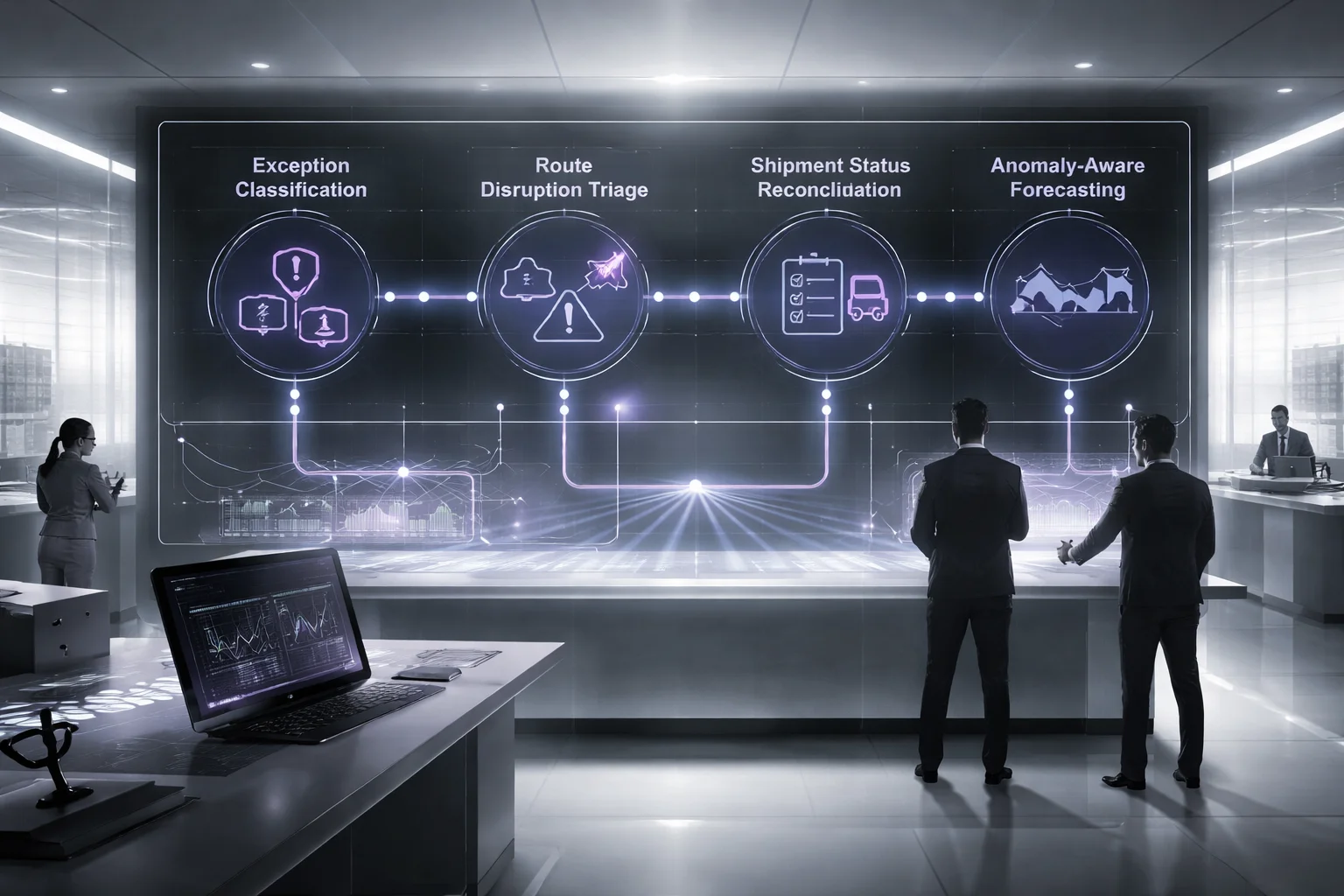
I think people overbuild this stuff. They create one giant “risk engine” as if damaged packaging, customs delay, route disruption, inventory mismatch, and a missing identifier are all the same problem wearing different hats. They’re not. Different owner. Different rule set. Different deadline. KNAPP has been pretty clear about where AI gets practical in warehouses: computer vision catching damaged packaging, incorrect identifiers, and quality issues early. That matters because early detection cuts exception density before bad freight and bad data spread across the network. Catch a label problem at packing, and one person fixes it in minutes. Catch it after a regional hub transfer, and suddenly three teams are in Slack, someone’s pulling EDI records, and nobody agrees on what happened first.
The middle of this whole thing—the part most teams skip—is ugly but decisive: status reconciliation inside an event-driven architecture. Not glamorous. Still the job. You have to keep comparing TMS status, carrier telemetry, EDI events, warehouse scans, and customer-facing promises as they come in. If observed state and predicted state split apart, trigger review or correction right then. Otherwise one stale feed starts poisoning everything downstream, and you get classic logistics automation failure modes: false confidence, wrong ETAs, late escalations, operators ignoring the system because it lied to them twice last week.
Here’s the framework I’d actually use.
1. Classify the exception by operational type.Not “high risk” or “medium risk.” Real type. Packaging damage isn’t customs delay. Inventory mismatch isn’t route disruption.
2. Assign an owner and a clock.Who acts? How fast? A missing identifier at pack-out might need action in five minutes. A customs hold runs on a completely different timeline.
3. Reconcile system truth continuously.TMS says one thing, carrier telemetry says another, warehouse scan says a third—don’t wait for humans to notice.
4. Choose a response lane based on cost.That’s where real-time decisioning earns its keep: classify event, score impact, choose response lane.
5. Forecast like tomorrow might not look like yesterday.Because sometimes it won’t.
Route disruption triage is where smart teams still get weirdly emotional. A late truck doesn’t always deserve full replanning. Sometimes the right move is an automatic carrier swap. Sometimes it’s just an ETA update to the customer and everyone carries on. Sometimes you wake a dispatcher immediately because each minute burns money. For AI route optimization with disruptions, that simple pattern—classify event, score impact, choose response lane—is better than panic dressed up as sophistication.
Forecasting breaks faster in exception-heavy networks than most people want to admit. Normal forecasting assumes yesterday still means something today. Fine—until a weather event or port delay spike wrecks that assumption by noon. You need anomaly detection feeding models built for forecasting under uncertainty, or delay-risk spikes get averaged into irrelevance like they never happened at all.
This isn’t theoretical busywork parked in an analytics deck somewhere no operator opens twice. AIintheChain reported a consumer electronics case where AI-based exception detection cut customer order delays by 22% in three months. Three months—not some vague five-year transformation fantasy. Speed matters here too, which is why cloud keeps winning these deals: ResearchAndMarkets, cited by Yahoo Finance, says cloud-based logistics AI will add $79.09 billion in annual sales by 2029 because companies want faster rollout and tighter feedback loops.
No, the answer isn’t “more AI.” I’d push back on that every time. The answer is patterns that survive contact with real operations: classify clearly, reconcile constantly, triage disruptions fast, forecast with anomalies in mind. That’s how exception management in supply chain becomes something operators trust instead of override. Fewer manual escalations. Faster recovery. More willingness to follow logistics AI for exceptions when things get weird. If that’s where you’re headed, start with predictive analytics forecasting for logistics planning. If your system can’t tell who owns the mess and what happens next, what exactly did you build?
FAQ: AI for Logistics Solutions That Handle Exceptions
What does AI for logistics exception handling actually mean?
It means using AI to detect, prioritize, and respond to disruptions like late shipments, inventory mismatches, customs holds, damaged goods, or route failures before they turn into expensive service problems. The useful version isn't just prediction. It connects real-time signals to decisioning, fallback policies, and human escalation so your team can act fast.
How does logistics AI fail when exceptions start piling up?
Most systems look smart in normal conditions and fall apart when exception density spikes. They miss anomalies, flood operators with low-value alerts, or recommend actions that break business constraints such as SLAs, capacity limits, or compliance rules. Actually, that's not quite right. The deeper failure is usually system design, not model quality alone.
Why is exception density such an important design constraint?
Exception density tells you how often your operation leaves the happy path, and that changes everything about system design. If your network sees frequent disruptions, you need event-driven architecture, fast re-ranking of decisions, and clear fallback paths instead of a single best-answer model. High-rate logistics AI design starts by assuming exceptions are normal, not rare.
How do you calculate logistics exception density?
A simple way is to divide the number of exception events by the number of operational units in a period, such as loads, orders, shipments, or route legs. You can also segment it by node, carrier, lane, warehouse, or customer tier to find where exception management in supply chain operations is breaking down. The number matters less than using the same definition consistently.
Can logistics AI automatically recover from disruptions?
Yes, but only for bounded cases where the system has clear constraints and approved actions. AI route optimization with disruptions can reassign loads, resequence stops, swap carriers, or adjust inventory promises if the rules, cost thresholds, and service priorities are already defined. For ambiguous cases, the system should pause and escalate instead of guessing.
Does exception handling in logistics AI still need humans?
Absolutely. Human-in-the-loop workflows matter because edge cases often involve tradeoffs the model can't safely resolve, like margin versus service recovery or customer priority versus network efficiency. The best systems automate routine exceptions and send only high-impact or low-confidence cases to operators.
What architecture works best for logistics AI that has to survive exceptions?
An event-driven architecture usually works best because it reacts to changes as they happen instead of waiting for batch updates. Pair that with anomaly detection, constraint-based optimization, decision services, monitoring and alerting, and a workflow layer for approvals and escalation. If your data arrives late or incomplete, even good models will make bad calls.
What components should an exception-ready logistics AI system include?
You want ingestion pipelines, data quality checks, anomaly detection, forecasting under uncertainty, optimization engines, policy rules, and fallback policies. Add audit logs, SLA tracking, simulation and stress testing, and role-based escalation paths so operators can understand why the system acted. That's what separates logistics AI for exceptions from a dashboard with predictions.
How should fallback policies be defined for routing, scheduling, and inventory decisions?
Fallback policies should specify what the system does when confidence drops, inputs conflict, or constraints can't be satisfied. For example, routing may revert to the lowest-risk carrier option, scheduling may freeze changes inside a cutoff window, and inventory decisions may require planner approval when projected stockout risk crosses a threshold. Write these rules before deployment, not after the first bad week.
How do you test whether logistics AI can handle stress and disruption?
Run simulation and stress testing with weather events, port congestion, missing scans, delayed EDI feeds, carrier no-shows, and sudden demand shifts. Measure not just model accuracy but recovery time, alert precision, decision latency, SLA impact, and how often fallback policies trigger. That's how you expose logistics automation failure modes before your customers do.
What metrics show data drift or performance degradation in logistics AI?
Watch input freshness, missing-field rates, feature distribution shifts, anomaly volumes, alert-to-action ratios, override frequency, and decision latency. Then tie those to business outcomes like OTIF, premium freight spend, exception resolution time, and customer complaints. If model confidence stays high while service performance drops, you've probably got data quality or data drift problems.