AI for Contract Analysis by Contract Type
Most contract review teams are wasting expert time on work a machine can finish before a human lawyer finishes coffee. That sounds harsh. It’s also getting...

Most contract review teams are wasting expert time on work a machine can finish before a human lawyer finishes coffee. That sounds harsh. It’s also getting harder to argue with.
AI for contract analysis is already posting numbers that make old review habits look expensive: 26 seconds instead of 92 minutes for contract review, and 94% accuracy on NDA review tasks, according to Leah AI. And the story gets more interesting once you stop treating every agreement like the same document. An NDA isn’t an MSA. A DPA shouldn’t be reviewed like a vendor paper. In the next six sections, I’ll show you why contract-type-specific AI models catch risk faster, classify clauses better, and give legal and procurement teams something they rarely get enough of: signal.
What AI for Contract Analysis Really Means
What kind of agreement is this?
I’m not answering that yet. Because most teams don’t start there either. They start with the shiny part: a legal ops manager at 4:47 p.m. on a Tuesday, sales insisting the file is “basically just an NDA,” procurement calling it vendor paper, privacy asking why there’s a data processing exhibit hanging off the back, and some AI tool kicking out a neat little summary in eight seconds like it just solved the room.
It didn’t. Nice summary. Wrong victory lap. If nobody knows what standards the document should be judged against, the speed barely matters. I’ve watched people stare at a beautifully organized output and still have no clue whether they should approve, escalate, or send it back covered in comments.
That’s why I think people oversell AI for contract analysis when what they really mean is faster summarization. Those aren’t the same job. If the system can tell you what the contract says but can’t help you decide how to evaluate it, you don’t have real decision support. You’ve got a polished reading aid with good manners.
TermScout has the right idea here: the useful systems turn contracts into structured, decision-ready data. Key attributes. Comparisons against market norms. Risk surfaced across a big stack of agreements instead of one lonely PDF at a time. Context changes the meaning of everything. A limitation of liability clause inside an NDA is one thing. Put that same issue inside an MSA and now you might be messing with the economics of the entire deal.
Clause extraction matters. Clause classification matters. Risk scoring matters. None of it survives contact with reality if the model hasn’t figured out what it’s reading first.
There’s your answer: type comes first.
But even that sounds cleaner than it is in practice. An NDA isn’t reviewed like an MSA. A DPA isn’t reviewed like either one. The approval thresholds shift. The fallback language changes. The regulatory exposure changes. The logic from the very first pass changes. So AI contract review by type isn’t some nice extra somebody adds after launch. It’s the whole game. Type-specific contract risk detection is the thing that separates actual contract intelligence from generic document AI wearing legal clothes.
ContractSafe gets at the practical side: AI can pull key data, sort agreements by type or department, and flag weak financial terms, IP ownership problems, or data security gaps. True enough. I’d still argue that extraction by itself doesn’t get you very far. The real move is contract type modeling. Figure out whether the document should be treated as procurement paper, privacy paper, or commercial paper before you start handing out red flags like candy.
The market numbers explain why this isn’t some side experiment anymore. Leah AI reports legal teams can save 82% of time on contract tasks through automation. Thomson Reuters found 20% of respondents were already looking to buy contract AI for analysis, risk assessment, or due diligence. That’s not curiosity money. That’s buying behavior.
If you’re building automated NDA MSA DPA review, keep it boring on purpose at the start. Set document typing rules inside your CLM flow. Write contract-specific policies for each category. Map clause extraction separately for NDAs, MSAs, and DPAs. Do the same with risk scoring instead of pretending one model should judge every agreement with the same brain. I once saw a team run this on 500 legacy contracts over a weekend and watch false alarms fall off fast once type got identified first.
We’ve seen the same pattern in AI for legal document review workflow integration. People obsess over workflow design early on. Fair enough. Then document type shows up and suddenly outranks almost everything else, because the “right” workflow depends on what kind of paper is actually sitting in front of you.
The smartest contract AI usually begins with an almost embarrassingly plain question. Not “What risks are here?” Not “What does this clause mean?” Just: what is this thing? Boring question. Expensive question if you skip it. So before your system scores anything, summarizes anything, or flags anything—does it know whether it’s looking at an NDA, an MSA, or a DPA?
Why Generic Contract AI Misses Type-Specific Risk
21%. That’s it. According to Leah AI, only 21% of organizations have reached broad AI integration in contract management. Honestly, that number doesn’t surprise me at all. If anything, I’m surprised it’s that high.

I’ve watched teams get seduced by the demo. The system pulls indemnification, termination, and liability caps in seconds. Everyone nods. Legal thinks review just got faster. Procurement thinks the bottleneck is gone. Then real documents show up, mixed together in one ugly batch, and the model starts making confident mistakes.
I did this once with a stack of agreements that included NDAs, MSAs, and employment contracts. For about ten minutes, it looked great — neat clause labels, tidy outputs, no obvious mess. Then we read the results like actual lawyers instead of impressed buyers. Bad idea hiding in plain sight: the model was treating those documents like cousins when they were really different species.
That’s the part people miss. An NDA isn’t reviewed like an MSA. It just isn’t. With an NDA, I care about confidentiality scope, residuals, permitted disclosures, and survival periods. With an MSA, my attention moves fast to liability caps, service credits, acceptance terms, IP ownership, and change control. A DPA? Different fight entirely: subprocessors, cross-border transfers, security measures, GDPR responsibility. A lease can turn on renewal mechanics and operating expenses. An employment agreement can go off the rails over restrictive covenants, termination rights, and local labor law exposure.
TermScout is right on the narrow point: AI can extract and categorize clauses like indemnification, termination, and liability limits faster than manual review. No argument there. But I think people stop one step too soon and call that intelligence. It’s not judgment. It’s sorting with good manners.
And sorting can be dangerous when it looks polished. If your tool assigns a liability cap issue in an NDA the same kind of weight it gives a liability cap issue in a master services agreement, your risk score isn’t smart — it’s theater. Clean dashboard. Wrong conclusion.
I saw one team review roughly 300 vendor contracts in a single quarter and keep escalating the wrong files because the model couldn’t tell “important clause” from “important clause in this kind of contract.” That’s how you burn money twice: first on wasted reviewer time, then again when the issue that actually matters slips through because everyone was staring at the wrong red flag.
This is why AI contract review by type isn’t some nice extra for phase two. It’s the whole engine. Without contract type modeling up front, the rest of the workflow is built on a bad assumption.
- Identify the contract family first. Use contract type modeling before review starts.
- Set policy by document type. What’s normal in an SOW may be completely wrong in a DPA.
- Score risk by consequence. A missed confidentiality carve-out creates one problem; a missed processor obligation creates another.
- Push that logic into CLM. Approval paths, fallback clauses, and exception handling should change automatically based on document type.
Thomson Reuters says AI can be tailored to specific legal domains and pre-trained with expert information. Good. That’s exactly the point. Weak type-specific contract risk detection doesn’t just miss issues — it creates false confidence, which is usually the more expensive failure mode.
If you’re serious about AI for legal and procurement teams, don’t build for applause in a product demo. Build for workflow. Tie document type to review logic. Tie review logic to approvals. Tie approvals to fallback language inside your CLM stack. That’s when something like AI for legal document review workflow integration stops sounding abstract and starts protecting margin, compliance, and reviewer hours.
So what should you do next? Audit your system on mixed contract sets, force it to classify document type before scoring risk, and check whether your approval rules actually change by agreement category — because if they don’t, what exactly is your AI reviewing?
How Contract Type Modeling Improves AI Accuracy
Everybody says the same thing about AI for contract analysis: feed it enough agreements, let it extract clauses, score risk, and watch review time drop. Sounds great. It’s also incomplete.
31%. That number tells on the market. Leah AI reports that only 31% of organizations have formal AI governance policies and procedures. I think that’s why so many contract review demos look polished for six minutes and then fall apart the second a real legal team asks, “Wait, what exactly did this thing think it was reading?”
The usual pitch is faster extraction. The missing piece is classification. If nobody has agreed on what counts as an NDA, an MSA, a DPA, or a procurement agreement—and where each one belongs once it enters the system—the model isn’t making careful legal judgments. It’s guessing with confidence.
I’ve seen this go sideways in one email thread. A procurement lead sent three “standard” contracts for urgent review. Same sender. Same rush job. Totally different documents. One was an NDA. One was an MSA. One looked like part of a vendor packet but was actually a DPA dressed up in procurement language. First-pass AI grouped them like they were basically the same species. It found clauses. It matched patterns. It still missed what mattered, because purpose beats formatting every time.
That’s where people get lazy with automation talk. Before extraction. Before scoring. Before anyone starts bragging about review coverage or automation rates. The system has to know what kind of contract it has in front of it and what that contract is supposed to do.
goHeather lists the modern spread: NDAs, MSAs, DPAs, SaaS agreements, employment agreements, leases, procurement contracts, and more. Sure, that breadth is real. It just doesn’t help much if the model can’t put each document in the right bucket first.
An NDA should trigger questions about confidentiality scope, exclusions, and survival periods. An MSA should send attention somewhere else: service levels, liability caps, IP ownership, change control. A DPA has its own checklist entirely—processor obligations, subprocessors, breach notice timing, transfer language. That’s why AI contract review by type matters. Without it, you’re not doing serious review. You’re doing generic labeling with nicer marketing copy.
Metadata gets treated like garnish. It isn’t. Real fields run operations: parties, governing law, renewal dates, data categories, liability amounts, approval thresholds. In one legal ops setup I worked on, missing a renewal date by even 14 days created an auto-renewal mess nobody wanted to explain on Monday morning. At one software company I saw, that kind of miss locked them into another 12-month vendor term worth roughly $48,000 before anyone caught it.
This is where contract intelligence becomes useful inside a CLM stack instead of just sounding smart in a slide deck.
Routing matters too, probably more than some vendors want to admit. Privacy terms should land with privacy counsel. Commercial fallback issues belong with legal ops or sales ops. Procurement exceptions should go to sourcing. That’s where type-specific contract risk detection starts affecting cycle time instead of producing another dashboard everyone stops opening after week two.
Ironclad says strong systems turn contracts into measurable business insight. I’d argue that only happens when automated NDA MSA DPA review is built on contract type modeling for AI for legal and procurement teams. Not “read everything the same way faster.” Read each document in context. Pull the facts that matter for that category. Route the work to the right owner. Score risk based on what deviation actually means in that specific agreement.
If you’re building this now, don’t start with every document under the sun. Start with five high-volume contract types. Define the clause classification map for each one. Define the required metadata fields for each one. Define who owns every exception path for each one. Then wire that logic into your workflow layer using tools like AI for legal document review workflow integration. That’s how accuracy improves before the model ever flags its first redline.
Why let it guess what kind of contract it’s looking at?
Type-Specific Analysis for NDAs, MSAs, and DPAs
Hottest take: most contract review tools don't fail because they're bad at reading. They fail because they read everything like it's the same document.
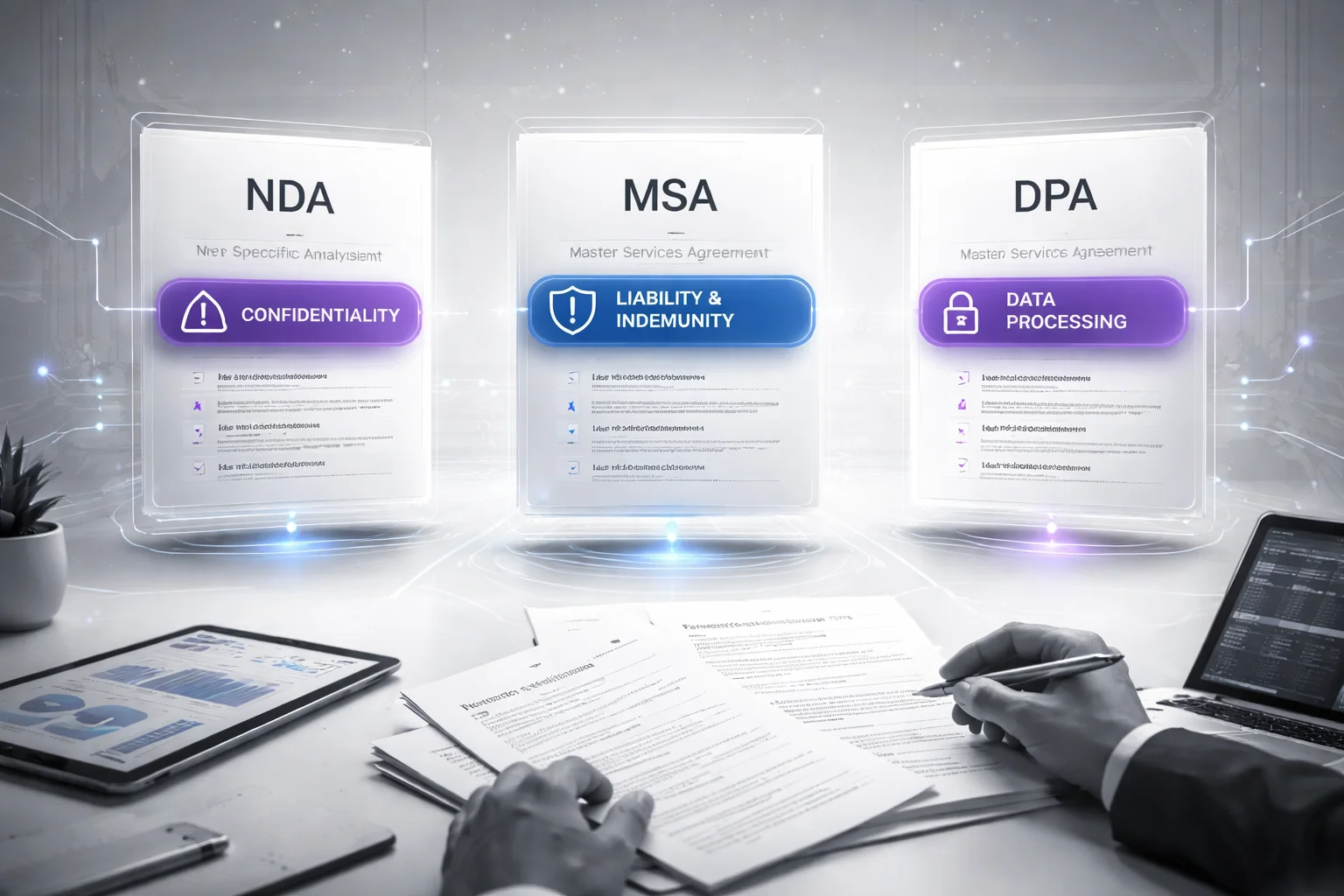
That's the mistake. Expensive one, too. An NDA isn't an MSA with fewer pages. A DPA isn't just compliance wallpaper stuffed in the back of the deal file. Put all three in one CLM folder and you've still got three different risk stories, three different priorities, three different ways to get burned after signature. I've watched teams run one generic model across all of it and act surprised when the real issue shows up two weeks later in redlines nobody escalated.
The funny part is the tech already told us this. RobinAI reported that retrieval-augmented generation cut the amount of contract text processed by 85%. That number doesn't say "read less carefully." It says the job was never to chew through more words. It's to find the few lines that can wreck the deal and stare at them harder than everything else.
I think "different review logic" is still too soft. What you actually need is type-aware analysis. Clause extraction changes by document. Clause classification priorities change by document. Risk scoring changes by document. That's what AI contract review by type means in plain English: stop pretending one checklist can cover NDAs, MSAs, and DPAs without turning into fancy skim-reading.
NDAs: this is usually a confidentiality-scope fight wearing business-casual clothes. The system should catch overbroad definitions of confidential information, weak exclusions, residuals clauses, long survival periods, and one-way disclosure rights hiding inside supposedly mutual language. It should compare recipient obligations against your fallback paper and rank exceptions by exposure. If an NDA lets the recipient use disclosed information for internal model training while your standard flatly bans that use, that's not some quirky wording note. That's a real review event. Full stop.
MSAs: liability allocation runs the room whether people admit it or not. Caps on liability. Indemnity structure. Warranty disclaimers. Service credits. Limitation carve-outs. Termination mechanics. This is where type-specific contract risk detection either proves it's worth paying for or becomes decorative software sitting on top of your workflow. A broad indemnity for third-party IP claims might be fine. An uncapped indemnity tied to data loss while SLA remedies are suspended might be a deal you should stop cold at 4:47 p.m. on a Friday before someone "just signs so we can move."
Yousign has pointed out that AI can analyze whole contract portfolios to benchmark terms and spot portfolio-wide risk concentration. That lands especially hard with MSAs. Legal sees one negotiation; procurement sees 200 vendor agreements slowly shaving margin in ways nobody notices until renewal season gets ugly.
DPAs: this is where data processing terms become the center of gravity. The model should pull processor-controller roles, subprocessors, breach notification timing, deletion and return duties, transfer mechanisms, audit rights, and security commitments. If a DPA shifts GDPR obligations in a way your privacy team won't approve, it should escalate immediately. Not "needs review" buried on page four. Not a timid yellow flag nobody opens until next Tuesday. That's the line between useful automated NDA MSA DPA review and shallow pattern matching.
The market's already moving like this matters because it does. Research and Markets projects the AI-powered contract analysis tools market will hit $12.06 billion by 2030. I'd argue that number isn't even the interesting part. The interesting part is how many teams will spend money on generic reviewers and still miss the clause that mattered.
If you're building AI for legal and procurement teams, ask for three things instead: type-aware policies, contract-specific comparisons, and escalation rules wired straight into workflow. If you want that working in day-to-day review without making operations worse, this guide on AI for legal document review workflow integration is worth a look.
The unexpected bit? The smartest system in the room might read less than everyone else — and catch more. So why are so many teams still rewarding volume over judgment?
Designing AI Contract Review for Legal and Procurement Teams
I watched a team celebrate a contract review that finished in 26 seconds. Great demo. Bad system. A supplier wanted signature by 4:30 on a Tuesday, the AI flagged a few clauses, everyone relaxed because the speed looked impressive, and the agreement still landed in the wrong queue because the routing logic was flimsy.
That's the trap. People act like the model is the product. I don't buy that. The flashy part is extraction accuracy, the stopwatch, the slick screen where software looks smarter than everybody in the room. Then legal and procurement get handed something they still can't trust when timing actually matters.
Leah AI puts the comparison at 26 seconds for AI review versus 92 minutes for a human. That's real. It's useful. It's also a fast way to make bad decisions if nobody has nailed down who sees what, when they see it, and why it got sent there in the first place.
The middle of this whole thing is contract type. People skip it because it's less sexy than speed numbers. It's the part that decides whether your system is helpful or annoying.
Concord showed why. Accuracy isn't one clean score you can slap on every agreement. It's about 99% for technology services agreements and 94% for healthcare contracts. Six points doesn't sound dramatic until it's your escalation path breaking because you treated every contract like it behaves the same way.
An NDA isn't an MSA. A DPA definitely isn't.
I'd build this inside the CLM flow first, not as some lonely AI review widget sitting off to the side pretending it's a system. Intake comes through the contract lifecycle management platform. The agreement gets classified. Clauses get extracted. Clauses get categorized. Risk gets scored using contract-type modeling. The route changes based on what actually showed up in the paper.
That's the framework I'd use:
- First, classify before you judge: know whether it's an NDA, MSA, DPA, or something else before anybody starts scoring risk.
- Then, score risk by type: use different logic for different agreements because category behavior isn't uniform.
- Then, route by consequence: send work to procurement, legal ops, counsel, or privacy based on what matters in that specific contract.
- Then, add humans at pressure points: not on every file, only where the terms can actually hurt you.
An NDA might move through light checkpoints. An MSA needs a different review path because commercial terms and liability usually get messy fast. A DPA should trigger privacy review by default every time, because weak processor terms are exactly the kind of problem people discover after signature when it's already expensive.
That's how automated NDA MSA DPA review turns into something AI for legal and procurement teams can live with day to day.
Approval bands are useful too, but only when they're tied to actual risk instead of somebody's vague comfort level.
- Low-risk: standard paper, no material deviations, auto-approve or send to procurement.
- Medium-risk: fallback language needed, route to legal ops or the category manager.
- High-risk: uncapped liability, non-standard data use, or missing processor obligations, escalate to counsel or the privacy lead immediately.
This is where type-specific contract risk detection stops sounding like marketing and starts doing real work. A renewal-term issue in an office services agreement isn't the same as weak subprocessors language in a DPA. Your system should know that before someone burns 15 minutes opening the file just to figure out what kind of mess they're holding.
LawVu has one point absolutely right: AI works best inside active CLM processes where it surfaces parties, renewal dates, and key terms for audits, reporting, and live risk review. That also means you shouldn't dump human-in-the-loop review onto every single contract at step one just so everybody feels safe for a week.
I learned this one the hard way: parallel processes rot fast. Wire outputs straight into your existing approval matrix, redline playbooks, and exception logs. Don't build some alternate universe no one maintains after quarter two. We mapped that handoff here: AI for legal document review workflow integration.
The upside is weirdly practical. Lawyers manually review fewer contracts. Procurement gets much better at spotting which agreements deserve legal attention before things go sideways. That's not automation replacing judgment. It's judgment finally getting backup.
If your system still can't tell an easy NDA from a risky DPA before a human opens the file, what exactly did all that speed buy you?
Building Differentiated Contract Analysis AI That Scales
What actually breaks first when contract analysis AI leaves the demo and hits a real company?

Not the slide deck. Not the benchmark. Not even the first NDA.
94%. Leah AI reported that number for NDA review accuracy, and sure, that's useful. I think it's also the kind of number that makes people relax too early. One clean metric on one document type can make a room act like the problem's basically done, when the ugly part hasn't even started yet.
You see it when the neat little test set turns into 8,000 live agreements spread across legal, procurement, privacy, and sales. Suddenly you're not reading one familiar NDA. You're dealing with MSAs that hide service levels in weird places, DPAs that drag in regional privacy obligations, and clauses that seem interchangeable until indemnity, liability, or data-handling language quietly changes the meaning. I've watched teams discover this around week six, usually after someone asks why a clause was caught in Template A and missed in Template B.
Spellbook gets closer to the real prize than most: extracting and comparing terms across large batches of repeatable contracts so you can find patterns, outliers, and deviations. That's the work. Not the flashy answer box. Repeatability is the thing nobody claps for and it's the thing that matters most. If a contract family doesn't recur often enough to teach the system something stable, you're guessing with better branding.
That's the answer. Data strategy breaks first. But model choices can still make the mess worse.
I'd argue people obsess over model size because it's easier than dealing with labeling discipline. Same story with prompt tricks. Same story with the vendor screenshot that shows one beautiful extraction result and somehow stands in for enterprise readiness. The systems that survive don't start with whiteboard architecture art. They start with separated training sets that reflect how contracts are actually reviewed in the business.
NDA data should stay with NDA data. MSA data should stay separate. DPA data too. Clause extraction datasets and clause classification datasets need to line up with real review workflows, not some tidy academic taxonomy somebody invented in February 2024 because it looked clean in a spreadsheet. Mix confidentiality language together with service obligations and privacy terms in training, and you'll get a nice-looking evaluation followed by chaos once live traffic starts coming through.
I've seen a limitation-of-liability clause tagged correctly in one template and missed in another just because the examples were blended badly. Same clause family. Same general issue. Different wording, different structure, wrong output. That's how expensive mistakes happen — not because the model is "bad," but because the setup was lazy.
The stack should be split by job. One layer figures out document type. Another handles extraction and classification. Then a decision layer handles type-specific contract risk detection. Yes, a general model can do parts of this. Usually? Not consistently enough for enterprise use, especially if teams want dependable AI contract review by type across thousands of agreements.
Evaluation has to be split the same way or you're fooling yourself. Type-aware or it's fake confidence. Strong NDA results don't prove your MSA risk scoring works. They definitely don't prove your automated NDA MSA DPA review setup is ready for production across departments.
And speed by itself means almost nothing. Concord reported review time dropping from 92 minutes to 26 seconds, which is impressive for exactly one reason: output only matters when it lands somewhere useful. Contract lifecycle management (CLM). Exception queues. Approval matrices. Audit logs. The actual systems used by AI for legal and procurement teams. If your results sit inside an isolated interface no one works in after day three, you've built a fast side project, not an operating system for review.
So yeah — build for separation, repetition, and handoff into real workflows already used by humans on Tuesday afternoon when they're tired and behind on approvals. Classify contracts correctly. Score risk in context. Connect outputs to downstream systems people already trust. That's how differentiated contract type modeling becomes enterprise-ready AI for contract analysis instead of one polished demo everyone remembers fondly and never deploys at scale. For more on the workflow side, see AI for legal document review workflow integration. What breaks first at your company — the model, or everything around it?
FAQ: AI for Contract Analysis by Contract Type
What does AI for contract analysis actually do?
AI for contract analysis reads agreements, extracts key terms, classifies clauses, and turns messy legal text into structured data your team can act on. That means it can flag risk, identify obligations, compare language against your playbook, and surface exceptions across large contract volumes without forcing lawyers to read every page line by line.
How does AI detect contract risk and missing clauses?
It looks for clause patterns, language variants, and deviations from approved standards, then applies risk scoring based on what’s present, missing, or unusually drafted. For example, it can catch a missing limitation of liability clause in an MSA, weak confidentiality survival language in an NDA, or incomplete processor obligations in a DPA.
Why do generic contract AI tools miss type-specific risks?
Because not every contract should be reviewed against the same checklist. An NDA lives or dies on confidentiality scope, exclusions, and survival, while an MSA needs deeper review of indemnities, SLA terms, payment mechanics, and termination rights, and a DPA has to map tightly to data privacy compliance requirements like GDPR.
How can contract type modeling improve accuracy?
Contract type modeling gives the system different review logic for different agreements instead of treating every document like a generic contract. According to Concord, AI accuracy in 2025 varied by contract type, including 99% for technology services agreements, which tells you the obvious but often ignored truth: type-specific models usually perform better than one-size-fits-all review.
What should AI analyze in NDAs, MSAs, and DPAs?
For NDAs, focus on confidential information definitions, exclusions, permitted use, disclosure rights, and survival periods. For MSAs, prioritize liability caps, indemnification, service level agreement terms, termination, pricing, and IP ownership. For DPAs, the model should inspect controller-processor roles, subprocessor terms, security measures, cross-border transfer language, breach notice timing, and GDPR data processing agreements requirements.
Can AI help legal and procurement teams review contracts faster?
Yes, and the speed gap is hard to ignore. According to Leah AI, contract review was completed in 26 seconds with AI versus 92 minutes by humans in 2025, and legal teams can save 82% of time on contract tasks through automation. Actually, that's not quite right. The real value isn't just speed, it's getting legal and procurement teams to the right exceptions faster.
Does AI for contract analysis integrate with CLM and e-signature tools?
It should, because isolated review creates more work than it removes. The best setups connect AI for contract analysis to contract lifecycle management (CLM), repository, intake, and e-signature systems so clause extraction, obligation identification, approval routing, and post-signature reporting all happen in one legal workflow automation path.
Is AI contract review reliable for compliance requirements like GDPR?
It can be reliable if the model is trained for the contract type and tested against the exact compliance rules you care about. A DPA review model, for instance, should check lawful processing terms, audit rights, security commitments, subprocessor controls, and transfer mechanisms, then route edge cases to counsel instead of pretending every privacy issue can be auto-approved.
What data and labeling are needed to build accurate contract type modeling?
You need a labeled set of contracts by type, clause classification examples, approved fallback language, exception outcomes, and risk annotations tied to real business decisions. If you want strong type-specific contract risk detection, label not just clause presence but clause quality, redline patterns, negotiation history, and whether a deviation was accepted, rejected, or escalated.
What metrics should teams use to evaluate AI for contract analysis?
Start with precision and recall for clause extraction, clause classification, and risk detection by contract type, not just one blended accuracy number. Then measure review time saved, false positive rates, exception handling quality, and whether the system catches the issues that actually change redline and markup suggestions, approvals, or business risk decisions.